
Medical discoveries don’t happen overnight. Often, it takes decades of research and development in the lab to deliver treatments that cure cancer outright or give patients precious time with their families.
Researchers say America’s thriving biotech industry is facing a threat of our government’s own making. They say it’s the result of major changes to federal grant funding imposed by the Trump administration.
Often referred to as Biotech Beach, San Diego’s research hub, experts say, finds itself in the dark about whether the federal government will deliver millions in funding. Researchers say it’s already caused shock waves in cutting-edge research and patient trials.
Research grants canceled
In the past year, the second Trump administration has imposed a series of changes to how grants from the National Institutes of Health are approved and funded. Researchers like Jeremy Berg, Ph.D., say they don’t understand why the highly successful formula was altered.
“Grants have been canceled or terminated in the middle of their projects, which is something that was basically unheard of in the past,” Berg said. “Definitely not how I would fund science if I were in charge.”
Berg ran the National Institute of General Medical Services for about eight years during the George W. Bush and Barack Obama presidencies. His institute was one of 27 that make up the National Institutes of Health.
Among its many missions is carefully reviewing which research grant proposals are the most deserving to be awarded billions of dollars in funding.
“These are very long and complicated proposals that take a lot of work to put together,” Berg said. “It’s very competitive, but I think it brings out the best science that way.”
NBC 7 Investigates analyzed NIH grant data and found a 9% drop nationally for the number of approvals for cancer research grants from the 2024 to the 2025 fiscal years. That funding comes from the National Cancer Institute, another one of the NIH’s many institutes.
Over that span of time in San Diego, six of the most well-regarded institutions saw their funding drop from about $103 million to $87 million, a 16% decrease. Those six institutions include:
- La Jolla Institute for Immunology
- Salk Institute for Biological Studies
- San Diego State University Foundation
- Sanford Burnham Prebys Medical Discovery Institute
- Scripps Research Foundation
- UC San Diego Moores Cancer Center
“That means there are lots of even [better] ideas that were left on the table,” Berg said.
NBC 7
NBC 7
UC San Diego eclipses the other five institutions in cancer grant funding. It’s nationally renowned for innovation in the lab as well as directly changing the lives of patients.
“We’re troubled by the lack of the government investment in science, clinical trials, oncology drugs for patients,” Dr. Diane Simeone told NBC 7.
Simeone is the director of UC San Diego’s Moores Cancer Center. She said researchers are losing sleep wondering how institutions like hers will cope with the cuts, changes, and uncertainty.
“We had a pediatric brain tumor grant that got canceled, and then months and months later, out of the blue,, finally got reinstated,” Simeone said. “People are going to come in the door with more advanced cancers. We’re going to have less options.”
A fundamental change in funding
In the past, the NIH doled out money for multi-year research projects one year at a time. Now, it allots all the money for a multi-year project in one big chunk. The end result is that there isn’t enough money left over to fund as many proposals.
Simeone said this couldn’t be happening at a worse time, as researchers are in the midst of a golden age for cancer research.
“Oh, my god, so many amazing breakthroughs,” Simeone said. “We have really moved the needle in cancer. And to have this lack of progress…. We are all worried that it’s gonna cause irreparable harm.”
Waiting for the money
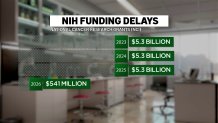
Typically, the NIH approves roughly $5.3 billion in cancer research funding every fiscal year. The amount that’s been distributed so far this year has alarmed researchers.
At just under six months into the current fiscal year, only $541 million in cancer research grants have been delivered. The impacts are already being felt.
NBC 7
NBC 7
“We have delays in people getting access to clinical trials,” Simeone said. “It’s very much disrupting the whole pipeline.”
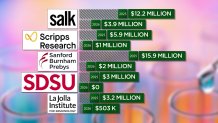
NIH data shows the impact on those six San Diego institutions. UC San Diego, which took in $46.8 million last fiscal year, has only been given $10.8 million. Sanford Burnham Prebys only has $2 million, compared with the $15 million it received last year.
NBC 7
NBC 7
The NIH budget was approved by Congress earlier this year. In fact, lawmakers increased the budget despite the Trump administration wanting to cut it by 40%.
While the NIH decides which grants get approval, it’s up to the White House’s Office of Management and Budget to deliver the funding.
“It’s very frustrating because if you haven’t gotten funded, you don’t know whether it’s going to be funded, and you just have to be patient, which can be a problem if you’ve got staff in place and so on that you need to pay,” Berg said.
“It’s driving us all crazy,’ Simeone said. “We’re hoping the funding will come in in May so we have uninterrupted funding, but that puts us all on edge.”
Berg believes funding decisions and delays are being used as a political weapon.
“I don’t think it has anything to do with fiscal responsibility,” Berg said. “They can put pressure on the universities to capitulate around other issues that have nothing whatsoever to do with biomedical research.”
In a statement, a spokesperson for the NIH blamed the government shutdown for the funding delay, saying it “remains committed to supporting rigorous, evidence-based, gold-standard science.”
Earlier this week, NIH Director Jay Bhattacharya reassured lawmakers that funding was on the way.
“My job is to make sure every single dollar goes out, and it will go out by the end of the year on excellent science,” Bhattacharya said.
Joseph Pandelinan
Joseph Pandelinan
The impact on patients
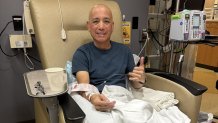
In 2021, Joseph Pandelinan had a nasty cough. His wife, believing it was a case of walking pneumonia, insisted he get it checked out by a doctor. It turned out to be much worse: Stage 4 lung cancer.
“When I was first diagnosed, there weren’t very many treatments for lung cancer,” Pandelinan said. “I wasn’t sure that I was going to survive that year.”
As they often do, doctors achieved what was once thought to be impossible. They bought Pandelinan time, moving him from one treatment to another.
That was unfortunately necessary, as some cancers mutate. Pandelinan’s tumors continually adapted to survive treatments. He has a favorite analogy to describe what his life’s been like since 2021.
“I felt like I was floating down the river on a lily pad, kind of looking around, and it was a beautiful day, and the water’s clear,” Pandelinan said. “There’s nothing else in the water, and I said, if the lily pad drops and fails me, I need to jump somewhere.”
Many of the new treatments Panelinan was forced to jump to didn’t exist when he was first diagnosed. Each was the result of years of research that came to fruition right on time.
“So I just think it’s irresponsible for people in the government to cut cancer research, research for deadly diseases…. I don’t understand it,” Pandelinan said. “You’re affecting people’s lives, people’s health, the ability for them to live a normal life, and it makes you angry.”
Just this week, Pandelinan was forced to leap off his latest lily pad. His landing spot: a promising new treatment that’s designed to specifically target his cancer cells, delivering chemotherapy to only what doesn’t belong.
“I just grabbed it as a heat-seeking missile,” Pandelinan said. “If we can attack the protein, we can turn the cancer off. They might not be able to cure it, but I’ve been told it’s almost like they can turn the switch off.”
Big shoes to fill for private fundraising
“I would imagine that every private funder at this point is getting inundated with requests for potential funding,” Berg said.
San Diego’s Curebound is a nonprofit with the sole mission of raising money for cancer research. CEO Robin Toth told NBC 7 Investigates that it is up to the challenge.
“It’s almost our moral obligation to give back,” Toth said. “I fear that we’re going to lose our competitive advantage as the United States as the innovation ecosystem that we are…. It is this moment for donors to rise up and fund research in a way like never before. We cannot afford to lose researchers, to have them leave the field of cancer research.”
Twenty years ago, Toth survived her own battle with colon cancer. It changed her outlook on life and became a new calling.
“We funded $51 million in cancer research to date and created $166 million in follow-on funding,” Toth said. “This means these researchers get to stay in the field and deliver on their dreams.”
That money may be small compared with the federal funding, but it’s been made even more vital by federal funding changes. Toth said the very nature of Curebound being private affords it the opportunity to fund types of research the NIH doesn’t.
“I mean, in the end, we’re all trying to get patients more time with their families and to have those precious and priceless moments,” Toth said.
Curebound has a track record of bringing in heavy hitters to accomplish its fundraising goals. That includes concerts with Elton John, Alicia Keys and Ed Sheeran. On May 15, they’ll welcome Pink to the stage at Petco Park.
“Pink is doing a two-hour performance with the high-flying Vegas-style show, all for cancer research,” Toth said. “We have direct philanthropy that goes 100% to the bottom line.”

Pandelinan is also part of Curebound’s mission, helping to raise money for a cause that will save the lives of future cancer patients and perhaps help add more time to a clock that started ticking when he was first diagnosed.
“Five years and two months, three days and six hours, but who’s counting? Haha! Who’s counting?” Pangelinan said.
About the Author

Discover more from USA NEWS
Subscribe to get the latest posts sent to your email.


