
Local News
Organizers handed a letter to university officials, asking for a revision of the signage policy.
A coalition of Boston University students, faculty, alumni, and staff gathered Thursday afternoon outside President Melissa Gilliam’s office to protest the removal of Pride flags from campus spaces earlier this month, calling on the university to reverse course and revise the university’s signage policy.
The rally, held at 1 Silber Way, was organized by Terrier Courage, a group that has collected more than 2,000 signatures on a petition urging the university to reconsider its rules on displays on public-facing windows and walls.
University officials have said the removals are tied to BU’s Events and Demonstrations Policy, which restricts signage in outward-facing windows.
During the demonstration, organizers delivered the petition to university leadership, addressing it to Gilliam and the Board of Trustees. The petition specifically calls for a revised policy that would allow signage on doors, windows, and walls in individual offices, dorm rooms, and private workspaces — regardless of whether those displays are visible from outside.
In the lobby, organizers handed the petition to Christine Wynne, BU’s vice president and chief of staff to the president, said Terrier Courage founder Jen Snyder-Cappione.
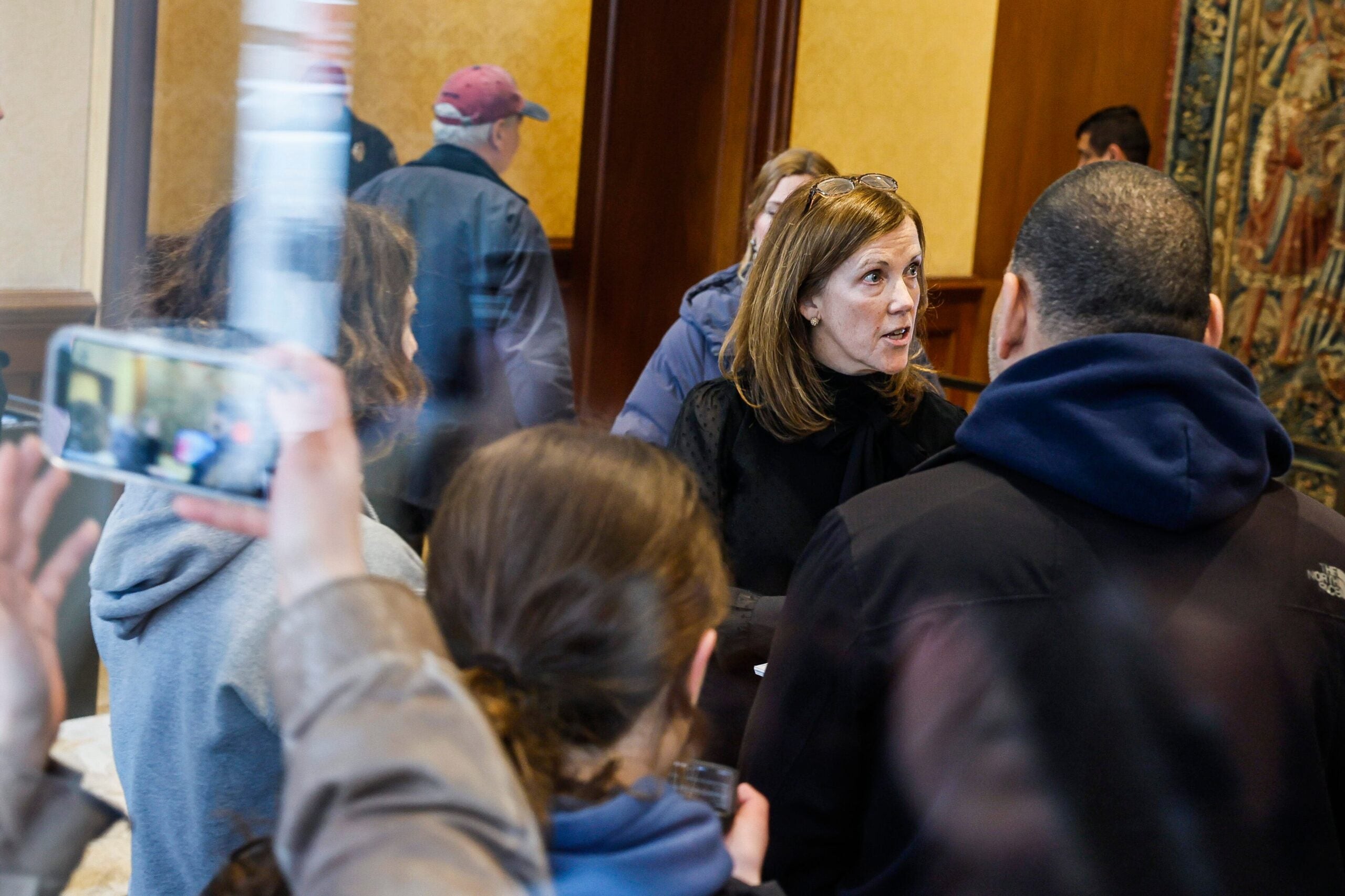
Gilliam did not attend the rally or receive the petition in person due to a scheduling conflict, communicated by officials, Snyder-Cappione told Boston.com.
Snyder-Cappione, who is also a professor at BU’s Chobanian & Avedisian School of Medicine, said she expects the petition to lead to further discussions with university leadership.
How the movement began
Snyder-Cappione said the coalition began forming about six months ago, bringing together students, faculty, alumni, and groups including BU’s chapter of the American Association of University Professors.
She traced her personal involvement to a conversation with university administrators about removing the phrase “DEI” from class materials.
“I just thought that was horrific, and so that’s kind of where this started for me,” she said. “I thought this could change life in America as we know it. This is enormous. You can’t just change language when you’re afraid of some consequence.”
The idea for the rally, Snyder-Cappione said, came as the petition quickly gained traction.
“Sometimes when people sign petitions, it feels empty,” she said. “Well, let’s show them that we’re going to hand deliver this petition, and we have no intention of accepting this rule at all.”
Faculty, students speak out
Nathan Phillips, a professor in BU’s College of Arts and Sciences whose Pride flag was among those removed, told Boston.com that the controversy has galvanized a growing campus response.
“My hope is that we are starting a dialogue with the administration that’s going to lead to a productive change in the policy, so that we can actually live up to the values and the principles that we actually claim to,” he said.
Phillips said his advocacy is rooted in personal connections to LGBTQ colleagues, students, and friends.
“So much of this is just about the humans that we know and supporting people and being caring for our community members,” he added.
Phillips shared a letter with Boston.com written this week by alumnus Yosef Abramowitz, who attended BU in the 1980s.
In the letter, Abramowitz references a 1986 Massachusetts Superior Court ruling in Abramowitz v. Trustees of Boston University, in which a judge found the university had violated the free speech rights of four students by threatening to evict them for hanging political banners from their dormitory windows.
“I am surprised that BU’s current leadership has stepped on the public and legal landmine of limiting free speech at a private university by ordering the taking down of public-facing pride flags from faculty offices,” Abramowitz wrote in the letter. “We settled that question 40 years ago.”
‘More than just a flag’
At the rally, speakers emphasized that the issue extends beyond free speech to questions of identity, safety, and belonging.
One of the rally’s speakers, Laura Jiménez, a professor at BU Wheelock College of Education & Human Development, told Boston.com that research shows visible symbols of inclusion can positively impact students’ mental health and academic success.
“[The Pride flag] was created to be inclusive, respectful, and simple, and it stands for love and inclusion,” said Jiménez, who identified herself as lesbian. “Removing the Pride flag among other symbols is against what the university stands for.”
Jimenez said her perspective is also shaped by her son, who attended BU.
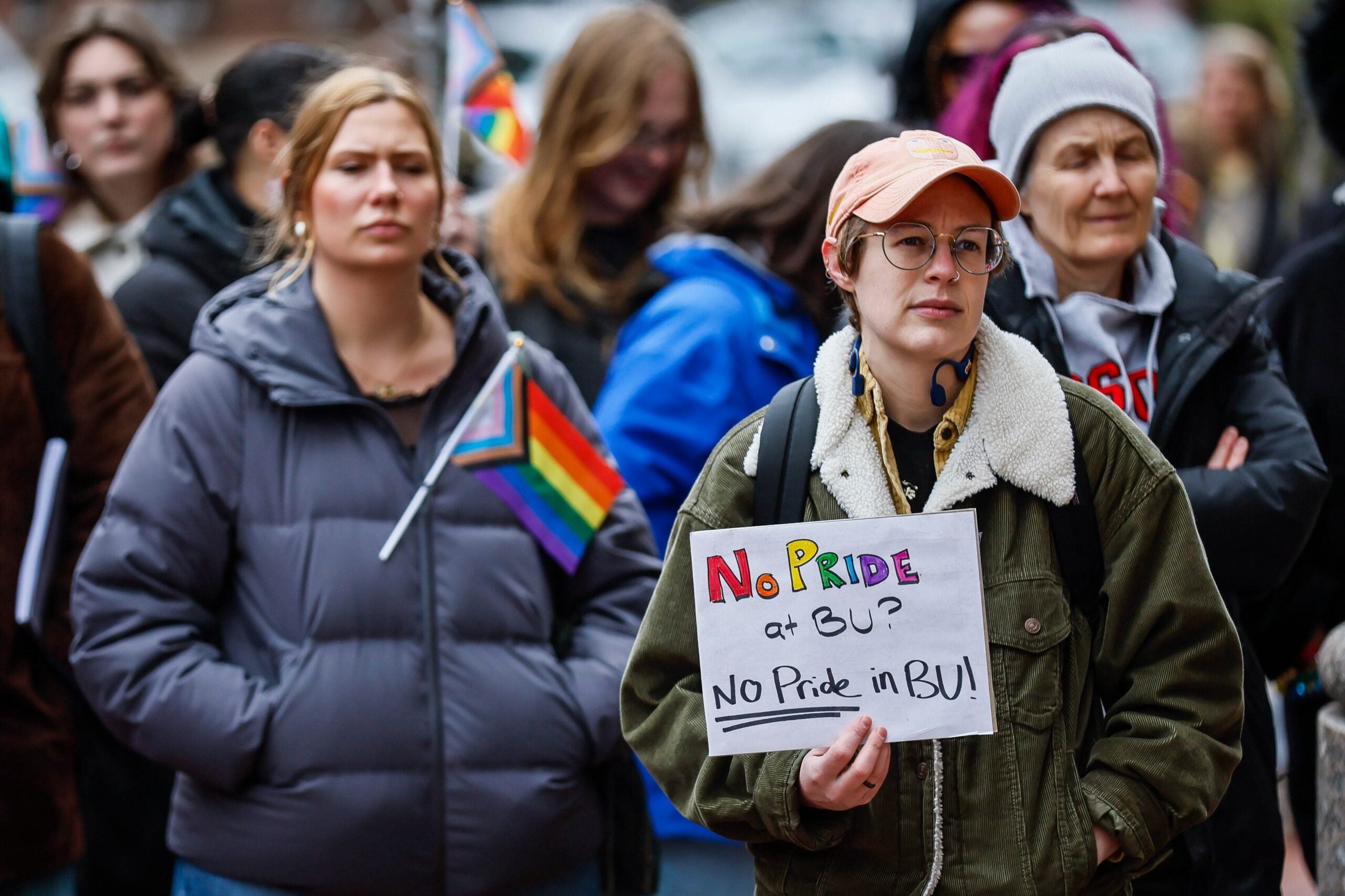
“I talked to him about this,” she said. “And he’s like, ‘This is stupid. Why is the university taking symbols down instead of having conversations if they’re problematic?’”
Jimenez referred to the poem “First They Came” by German pastor Martin Niemöller, written in the aftermath of World War II. The poem ends with the line: “Then they came for me—and there was no one left to speak for me.”
“I remember the end of that poem, and to me, this is the first step in BU bowing to [an] authoritarian regime,” Jimenez said.
Third-year BU law student Vanessa Feola Soto told the crowd she is frustrated not only by the administration’s actions but by efforts to frame the issue solely as a First Amendment debate.
“The LGBTQ+ persons are not a viewpoint. We’re not an ideology. We are not one side of a politically contested issue,” she said. “We’re a reality. We’re part of this community, and the Pride flag isn’t just any old flag. Pride flags are sacred symbols of representation and celebration for our community.”
Concerns over campus climate
Demonstrator Karina Martinez, a BU alum and staff member, told Boston.com she came out as lesbian as a student on campus and has watched the university evolve over time.
“It’s painful and sad to see the way that the university is transformed, and I watched the growth of it becoming more accepting,” Martinez said, pointing to the recent creation of the LGBTQIA+ Student Resource Center. “To already see steps back has been so jarring.”
The university has described the policy as “content-neutral,” a characterization which Martinez said she disagrees with.
“You can’t be neutral if you’re taking down Pride flags,” she said. “That, in itself, is a statement being made.”
Second-year law student Aisling Flaherty said she was also motivated to attend the rally in response to the “content-neutral” characterization. She noted the policy dates back to the 1980s but has only recently been enforced more prominently.
“The school is saying in their FAQ that it’s not out of concern for any federal government retaliatory measures, but it does feel a bit like preliminary compliance,” Flaherty said, referring to a BU Today article addressing the policy.
Recent graduate Ruby Hawes, who identifies as non-binary, said BU had once stood out as an accepting environment, particularly for LGBTQ students.
“This was one of the first spaces I saw that reflected in higher leadership and staff, and it felt like a safe place for me to come,” Hawes said. “Having that retracted is terrifying. The school has been so liberal, so active, and to see the passivity now is incredibly disappointing.”
Sign up for the Today newsletter
Get everything you need to know to start your day, delivered right to your inbox every morning.
    !function(f,b,e,v,n,t,s)
    {if(f.fbq)return;n=f.fbq=function(){n.callMethod?
    n.callMethod.apply(n,arguments):n.queue.push(arguments)};
    if(!f._fbq)f._fbq=n;n.push=n;n.loaded=!0;n.version='2.0';
    n.queue=[];t=b.createElement(e);t.async=!0;
    t.src=v;s=b.getElementsByTagName(e)[0];
    s.parentNode.insertBefore(t,s)}(window, document,'script',
    'https://connect.facebook.net/en_US/fbevents.js');
                const onetrustStorageConsent = JSON.parse(localStorage.getItem( 'consent_one_trust_bdc' ) );
        if ( ( onetrustStorageConsent !== null ) ) {
            /* The above code is parsing the JSON data from the local storage and storing it in a variable.
             * Checking if the user has given consent for the cookie C0004.
             * If the user has given consent, the variable consent will be set to 'grant'.
             * If the user has not given consent,the variable consent will be set to 'revoke'.
             * Documentation https://developers.facebook.com/docs/meta-pixel/implementation/gdpr
            */
            if ( onetrustStorageConsent.C0004 !== true ) {
                fbq('consent', 'revoke');
                fbq('dataProcessingOptions', []);
            } else {
                fbq('consent', 'grant');
                fbq('dataProcessingOptions', ['LDU'], 0, 0);
            }
        }
            fbq('init', '989222871864976');
    fbq('track', 'PageView');


    !function(f,b,e,v,n,t,s){if(f.fbq)return;n=f.fbq=function()
    {n.callMethod? n.callMethod.apply(n,arguments):n.queue.push(arguments)}
    ;if(!f._fbq)f._fbq=n;
    n.push=n;n.loaded=!0;n.version='2.0';n.queue=[];t=b.createElement(e);t.async=!0;
    t.src=v;s=b.getElementsByTagName(e)[0];s.parentNode.insertBefore(t,s)}(window,
    document,'script','https://connect.facebook.net/en_US/fbevents.js');
                const onetrustStorageConsent = JSON.parse(localStorage.getItem( 'consent_one_trust_bdc' ) );
        /* The above code is parsing the JSON data from the local storage and storing it in a variable.
         * Checking if the user has given consent for the cookie C0004.
         * If the user has given consent, the variable consent will be set to 'grant'.
         * If the user has not given consent,the variable consent will be set to 'revoke'.
         * Documentation https://developers.facebook.com/docs/meta-pixel/implementation/gdpr
        */
        if ( ( onetrustStorageConsent !== null ) && (onetrustStorageConsent.C0004 !== true ) ) {
            fbq('consent', 'revoke');
            fbq('dataProcessingOptions', []);
        } else {
            fbq('consent', 'grant');
            fbq('dataProcessingOptions', ['LDU'], 0, 0);
        }
            fbq('init', '813236348753005');
    fbq('track', 'PageView');
About the Author

Discover more from USA NEWS
Subscribe to get the latest posts sent to your email.


