
As global tensions rise amid the conflict in Iran, some Chicago-area faith leaders are raising urgent concerns about the use of religious language to justify war and nationalism.
For them, the issue is not just political — it is both deeply theological and deeply troubling.
“Diplomacy and dialogue have to be the pathway forward for a genuine peace,” Cardinal Blase Cupich, who leads the Archdiocese of Chicago, said in an exclusive interview with WBEZ and the Chicago Sun-Times on Thursday. “Peace can’t be imposed by force. It never works.”
Cupich’s remarks come on the heels of Pope Leo XIV’s criticism of U.S. President Donald Trump’s increasingly belligerent social media posts. They include a profanity-laced Easter message demanding that Iran open the Strait of Hormuz by Tuesday, “or you’ll be living in Hell – JUST WATCH! Praise be to Allah,” followed by a threat to wipe out Iranian civilization. The American pope called Trump’s comments “truly unacceptable.”
“Many people throughout the world echo those sentiments,” Cupich said.
A similar view was held by wide range of local faith leaders who spoke this week to WBEZ and the Chicago Sun-Times. While many observers have criticized Iran’s repressive theocratic regime, this group of religious leaders was also concerned about the Trump administration’s escalating rhetoric.
“I think the Holy Father is calling on all warring parties to put aside their weapons, not just in the Middle East,” Cupich said, “but also the conflict that we have in Ukraine and with Russia and the war that’s being fought throughout the different places of the world.”
On Wednesday, White House Press Secretary Karoline Leavitt defended President Donald Trump insisting he retains the “moral high ground” against Iran and calling his remarks a “very strong threat” that delivered results.
But Trump isn’t the only one explicitly citing Christianity to bolster the administration’s case for military action in Iran.
During a press briefing at the Pentagon on Wednesday, U.S. Secretary of War Pete Hegseth praised the last-minute ceasefire, declaring, “Our troops, our American warriors, deserve the credit for this day. But God deserves all the glory. Tens of thousands of sorties, refuelings, and strikes, carried out under the protection of divine providence. A massive effort with miraculous protection.”
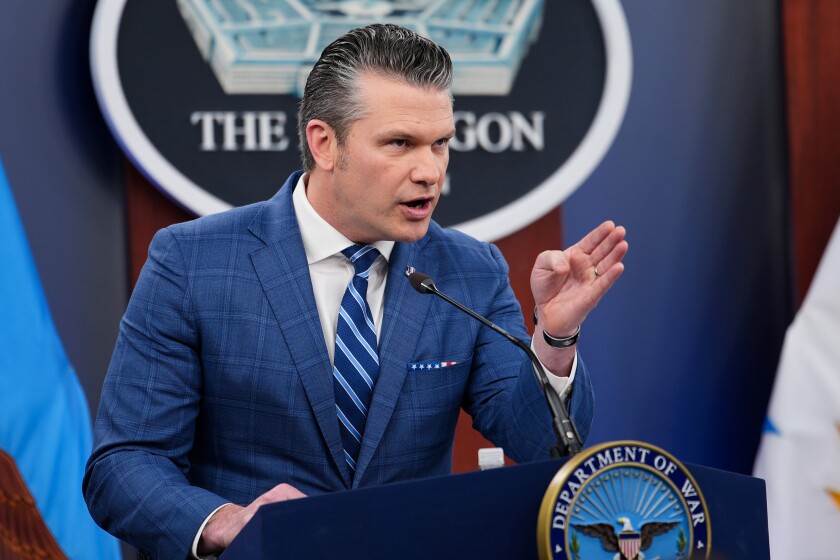
U.S. Secretary of War Pete Hegseth speaks during a press briefing at the Pentagon on April 08, 2026 in Arlington, Virginia. It was announced that a temporary ceasefire has been reached between the U.S., Iran, and Israel, pausing attacks for about two weeks while Iran reopens the Strait of Hormuz and negotiations continue toward a longer-term agreement.
Previously, Hegseth had compared the rescue of a downed pilot on Easter Sunday to the resurrection of Jesus Christ.
“We’re all very pleased and rejoiced that the pilot was rescued and is able to receive treatment for injuries that he received,” Cupich said.
But Cupich cautioned against relying on biblical references to advance war aims.
“It’s not the first time that political leaders have tried to compromise scripture and the Word of God for their own purposes, and I think most people see through that,” Cupich said. “It seems to me to be a pretty weak argument if that’s the stretch you have to make in order to justify your actions.”
‘Ill-timed and unhelpful’
“I have seen some statements from the President and Secretary of War that I am happy with, and some I take issue with,” said Pastor Jon Herr of Christ Covenant Church of Chicago, which is affiliated with the conservative Communion of Reformed Evangelical Churches (CREC).
Last year, Secretary Hegseth said he was proud to be a member of a CREC congregation outside Nashville, Tennessee. Hegseth frequently invokes his evangelical faith in depicting a Christian nation trying to vanquish its foes with military might.
In an email, Herr pointed to CREC’s governing documents that state: “Christians are called by our Lord to be peacemakers. We therefore renounce all acts of aggression and terrorism, while recognizing the right to self-defense for individuals and nations. Combat is lawful when it defends life, liberty, and property against criminal action. Biblical principles of warfare must be followed, never returning evil for evil.”
“Whether Secretary of War Hegseth’s words are in line with these standards or not, I desire that the actions of the United States military would be in line with these biblical standards,” Herr wrote.
“I was very disappointed by President Trump’s Easter morning social media message,” Herr continued. “The President’s message, especially with its mention of Allah, was very ill-timed and unhelpful.”
‘Idolatry dressed up in conviction’
The Rev. Quincy Worthington, pastor of Highland Park Presbyterian Church in Highland Park, went even further.
“I find it absolutely shocking and abhorrent that they would try to co-opt and use the language of faith to support this war,” Worthington said. “The talking of wiping out an entire civilization is antithetical to just about every single Christian ethic I’ve read, and antithetical to the gospel and teachings of Jesus Christ.”
Worthington said he knows some of his congregation attends church for comfort and guidance, but he argued that churches risk irrelevance if they retreat and avoid difficult conversations.
“Our role as clergy is to help people make sense of the world theologically,” he said. “That includes asking what it means to live faithfully in moments like this.”
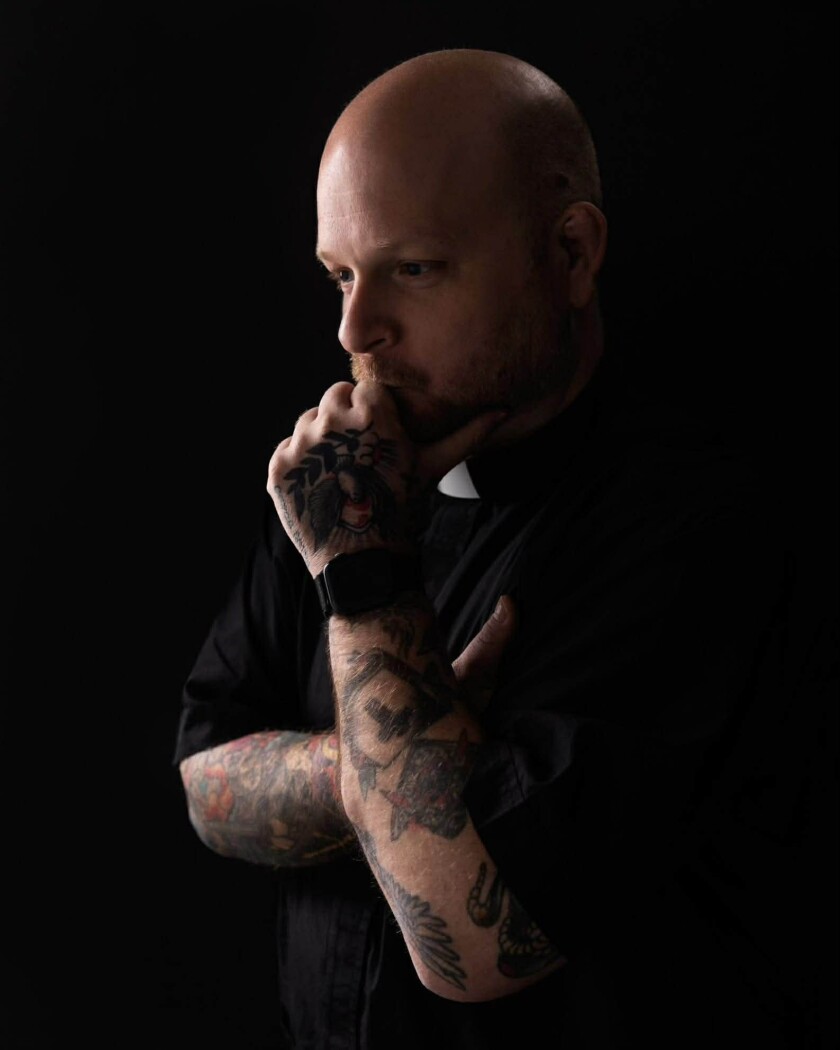
Central to his critique is what he and others identify as the rise of Christian nationalism — a blending of religious identity with political power.
“It becomes idolatry dressed up in conviction. The recent public rhetoric around the war has included explicit claims that God is on the side of the United States,” Worthington said. “We can’t use God to baptize national ambitions. That’s not the way it works.”
The Rev. Kristin Hutson of Edgewater Presbyterian Church in Chicago echoes that concern, describing a growing divide within American Christianity itself.
One version “is shaped by the ethics of Jesus, which are grounded in justice and care for the poor, liberation from oppressive powers,” Hutson said. “Then you have this other version of ‘Christianity’ that is shaped by … a strange fascination or fixation with power. Kind of rejoicing around things like violence. I think it’s got a lot of grounding in toxic masculinity and American exceptionalism.”
‘God is not a tool in the hands of politicians’
Imam Hassan Aly, director of the Humanitarian Faith Initiative at MedGlobal in Chicago, agrees that religion should never be weaponized.
“At its core, faith in general means to guide us towards justice, mercy and peace, not to justify violence. As people of faith, we believe God is not a tool in the hands of politicians,” Aly said.
Aly said framing the conflict with Iran as a holy war is both misleading and dangerous.
“The situation is far more complex, involving people and allied alliances from many faiths and backgrounds,” Aly said. “We have to understand that not everybody in Iran is Muslim or Christian or Jews. It’s a diverse country just like other countries.

Aly said many of the Gulf countries, which are allied with the United States, are also majority Muslim.
“It’s very, very complicated. Reducing it to be a battle between the religions only deepens division and makes peace harder to achieve when political leaders invoke God or use sacred language or quote from sacred holy texts to support military actions,” he said, adding many serving in the U.S. Armed Forces are also practicing Muslims.
‘There are no brakes’
Theresa Gross-Diaz, a historian and co-director of the Medieval Studies program at Loyola University Chicago, points out that religious justifications for war are not new.
In the Middle Ages, both Christian and Muslim leaders often spoke in terms of divine will or religious superiority. But that kind of language can be far scarier coming from a nuclear superpower led by a war secretary who has approvingly cited the 11th-century Christian invasion of the Holy Land known as the Crusades.
“What Trump and his supporters are doing now is perhaps even more alarming. They are using apocalyptic rhetoric which evokes end-times scenarios. The apocalyptic context is the expectation of global conversion, final conflagration, and Last Judgment, ushering in the end of the world and the Second Coming of the Messiah,” Gross-Diaz wrote in an email. “That’s really terrifying, since it suggests that a global conflagration would ultimately be a good thing. There are no brakes.”
Cupich said the Catholic Church’s stance against the war shouldn’t be seen as a sign of being anti-American.
“America has always been a country in which different views are expressed. That is the First Amendment that we have that protects that free speech and we’re better off when we listen to the voices of each other,” Cupich said. “I think that it’s at the heart of democracy that people who have solid reasons for opposing a particular policy speak up. We’re being patriotic when we do so.”
About the Author

Discover more from USA NEWS
Subscribe to get the latest posts sent to your email.


