
When Anyeli Miranda and her family arrived in Chicago from Guatemala about seven years ago she felt like a fish out of water.
A big part of that was the language barrier she faced as a native Spanish speaker. Back home she took some English classes but knew mostly basic phrases, such as how to introduce herself. That made it challenging to connect with her classmates when she started sixth grade in Chicago.
“At first, it was a little bit difficult to adjust, to make friends, find people that will let you be part of their group,” Anyeli said.
Now a senior at Roosevelt High School in Albany Park, Anyeli thinks back on those years with pride because of how far she’s come. She’s getting ready to go to college next year to study nursing, and she’s proven her skills in both Spanish and English, which she no longer sees as an obstacle.
Though it isn’t official yet, Anyeli’s graduation diploma will have a seal of biliteracy, making her one of thousands of Chicago Public Schools students who have earned a state award that recognizes students who show they can read, write and speak at a high level in English and another language.
Last year, more than 3,500 CPS students earned the seal, a new record. That was much higher than in 2015, the first year awards were presented to graduates, when 91 students received the recognition. The total number of Illinois students who earned the seal last year also hit an all-time high.
Educators and experts say that growth is due to a combination of factors, including increased awareness of the program among families, expanded language testing and a rising interest in multilingualism, which can make students more marketable when applying for colleges or jobs.
It can also be a financial boon. Public colleges and universities in Illinois award college credit to students who have the seal, saving them time and money as they work toward their degrees. And students say the award makes them proud of themselves and their skills.
“I think it’s important to have because it’s a good opportunity that will open doors,” Anyeli said.
Why high schools are awarding more seals of biliteracy
In 2013, Illinois became the third state to establish a state seal of biliteracy. The first awards were presented to graduates in 2015, when around 500 students earned a seal in 10 different languages. Over the last decade, the number of recognitions has grown. Last year, nearly 11,000 students in Illinois earned the seal in 62 different languages.
Students who come close to meeting criteria for the seal can receive a commendation toward biliteracy, which recognizes their progress. A higher number of students are earning that commendation, too.
That reflects a growing interest in bilingualism after schools and educators spent many decades emphasizing English skills, often at the expense of students’ home languages — though the Trump administration has tried to bring back this English-only focus.
In CPS, English learners make up a growing share of students who are earning the seal. English learners represented 13% of biliteracy seal recipients last year, up from 7% in 2024. Meanwhile, the portion of awards that went to students classified as former English learners last year dropped to 54% from 60% in 2024.
CPS graduates primarily earned the recognition in Spanish last year, but students also got seals in dozens of other languages, including Swahili, Afrikaans, Pashto and Nepali. That’s largely due to an expansion of the tests approved to evaluate students’ language proficiency.
To earn the seal, students are tested on their listening, reading, writing and speaking skills, typically on a computer. But students can also qualify for the seal by scoring high on their AP language exams, SATs or by taking certain college-level courses.
Roosevelt is one of the few high schools in CPS with a dual language program, which can help students prepare for the seal by offering rigorous coursework in two languages.
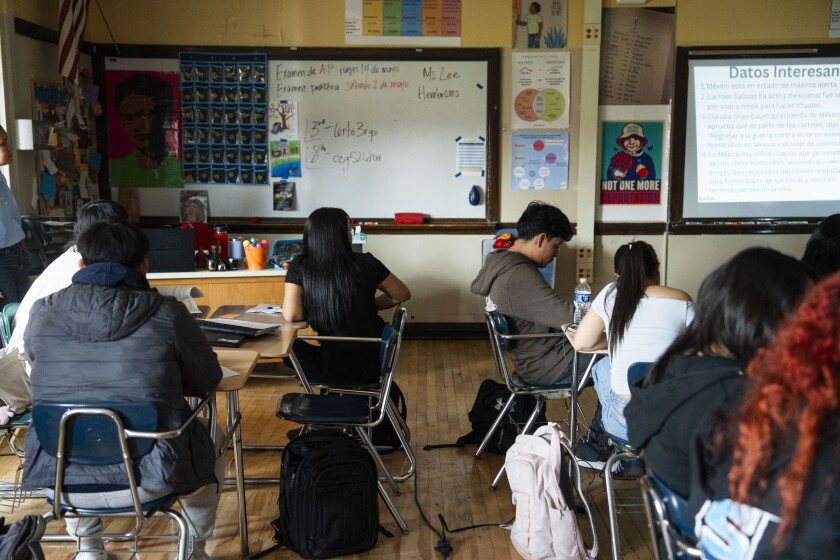
During a recent AP Spanish class, for example, Roosevelt students listened intently to their peers giving a presentation about recent cartel violence that broke out in Mexico, all in Spanish.
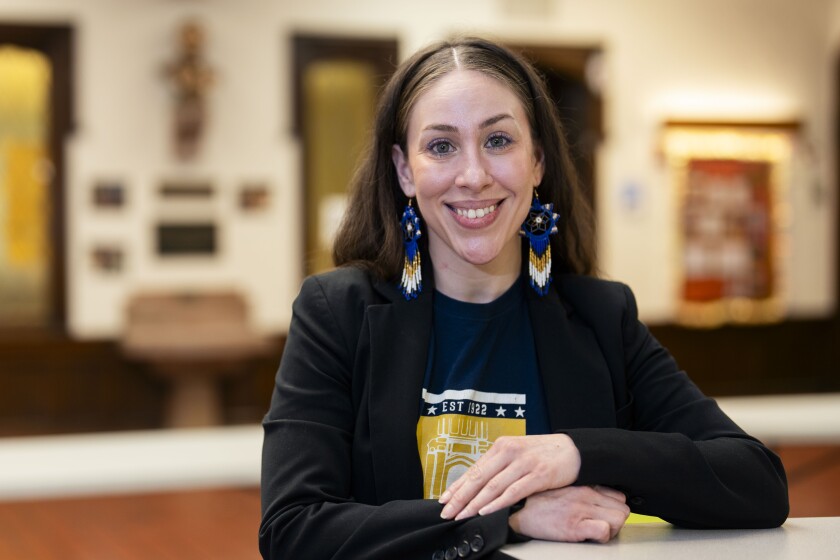
Natalie Cuevas, the dual language coordinator at Roosevelt, said it takes a collaborative effort among staff to determine which students might be good candidates to take the test. Sometimes students approach her about it, but she also reaches out to families and teachers, often in world language and English classes, to let them know about the opportunity.
She’s also spread the word by making classroom presentations, putting up posters and posting on social media. That encouraged more Roosevelt students to go after the seal. Last year 42 students at Roosevelt earned the seal of biliteracy, including firsts in the state for Pashto and Afrikaans, Cuevas said. She expects more will earn the award this year.
Students say seal instills pride and boosts job marketability
Nicole Skorupsky, who graduated last year from Rickover Naval Academy in Portage Park, was among the first CPS students to earn a seal in Hungarian.
Skorupsky was born in the U.S., but her parents are from a region in western Ukraine where Hungarian is spoken. The couple came to the U.S. in the 1990s. Skorupsky grew up speaking Hungarian and Ukrainian at home.
American movies helped Skorupsky learn English, as well as the dual language program at her elementary school. But her parents also made sure their daughter didn’t lose her native languages. They enrolled her in a Hungarian Saturday school, and they spoke Ukrainian at home.

Skorupsky, now a freshman at Loyola University Chicago, said those efforts inspired her to ask about taking the seal of biliteracy test in Hungarian when she entered high school.
“I knew that if I was to pass it, I would make my family proud because my family put so much effort into teaching me the language,” Skorupsky said.
She also thinks it’ll help with finding a job because Hungarian is one of the most difficult languages for English speakers to learn, and the seal proves she took the time to become proficient.
“My future employers, my future colleges, will also see that I learned such a hard language and that I can speak it, so it’ll just help me overall,” Skorupsky said.
James Cohen, president of the nonprofit Illinois Association of Multilingual Multicultural Education, said studies have shown that people who know more than one language have increased job opportunities and often earn higher wages.
“They actually make more money if they’re biliterate and bilingual,” Cohen said. “You’re more marketable.”
It may also help high school graduates show they are well-rounded, which gives them a leg up when applying for colleges, Cohen said.
Cuevas said the program would have helped her in her career had she been able to earn a seal of biliteracy when she was a student.
“As a bilingual teacher I had to go back to school, take additional classes, take a test to prove that,” Cuevas said. The seal of biliteracy would have made it easier to show colleges and employers the skills she already possessed, she said.
Anyeli feels more capable and confident as she inches closer to officially earning her seal of biliteracy at graduation.
“It has also increased my knowledge,” she said. “I have a mind that is more open, that thinks quicker.”
Now she’s helping her parents improve their English. She said she tries to accompany her mom when she runs errands in case there’s no one around who speaks Spanish. Those trips remind her that language barriers can prevent people from getting what they need.
“For example, in hospitals sometimes people don’t speak Spanish, so it can be a little complicated getting help,” Anyeli said.
That’s why she’s determined to reach her goal of becoming a nurse.
“I feel very proud of myself, for the effort I put in,” Anyeli said. “I remember that 12-year-old girl who didn’t know English, and I’m proud of who I am now.”
About the Author

Discover more from USA NEWS
Subscribe to get the latest posts sent to your email.


