
Efrain Aguirre got lost as he tried to find his classes in Schurz High School’s massive brown-brick building that has four floors and takes up an entire city block.
But he felt encouraged when Schurz students graciously pointed him in the right direction. That kindness gave him “a little confidence” that he would eventually feel okay about going to school there.
It has only been a week since the junior left Aspira Business & Finance High School, one of two schools run by the financially distressed Aspira charter network that is in the process of an unprecedented midyear school closing.
At a welcoming event in Schurz’s gym on Wednesday, Efrain said he still felt “questionable” and “worried” about transferring to the neighborhood high school in Irving Park on the city’s Northwest Side.
“I am pretty new here and I just started talking to people to see if I could find friends,” said the skinny teenager wearing a blue sweatshirt, who was the only one from his friend group to enroll in Schurz.
As Aspira closes its schools, Chicago Public Schools faces some important questions. Among them: Can it successfully usher some 570 teenagers to new schools in March without some students falling through the cracks? And can it do anything now to make sure students at other privately run schools with financial issues don’t experience a similar kind of disruption?
CPS officials have promised to provide bus cards, tutoring and mental health support to Aspira students and to waive their student fees. The district is also putting a transition coordinator at schools that take in a lot of students, like Schurz.
Conrad Timbers-Ausar, the interim chief of the CPS department that oversees charters, said district staff are reaching out to each Aspira student to make sure they get into a school “that meets their individual needs.” He said some students are still “maybe not sure where they want to go.”
Over the past two weeks, more than 540 students left Aspira schools. About 30 students were still officially enrolled as of Thursday at Aspira’s two campuses.
Several publicly funded, privately run schools in Chicago have closed in recent years. But Aspira’s wind-down is different from these other schools, almost all of which closed in the summer, allowing students to transfer at the start of a new school year, when other new students are showing up, too.
Another difference: Aspira leaders initially fought their closure and sent mixed messages to families about whether they should find new schools, making the transition even harder for some students.
Charter trouble gives neighborhood high school a boost
Aspira’s financial troubles have been apparent for months. CEO Edgar Lopez announced in November that the charter network did not have enough money to make it through the school year. The district provided cash advances this fall, but last month CPS officials said the amount Aspira needed was beyond what they could legally provide.
Before Aspira students were officially told to transfer, some said they were nervous to attend a nearby high school, like Schurz, because they’d heard about safety issues.
Lopez says some students have already come back to Aspira, complaining about the neighborhood schools they transferred into. He said he was concerned that CPS encouraged students to attend four “underperforming neighborhood schools.” Now he’s urging his former students to attend Intrinsic Schools’ Belmont campus, a nearby charter that’s one of the higher performing schools in the area.
But for Schurz and other neighborhood high schools, the closing of Aspira’s campuses represents an opportunity. They have seen enrollment declines for two decades as families have had fewer children, moved out of the city, or chosen to send their children to other schools. Taking in lots of students midyear could end up stabilizing their enrollment.

Twenty-five years ago, Schurz’s hulking building was almost at capacity with more than 2,500 students. But it started this school year with about 1,000.
Schurz’s principal, Heidy Moran, knew it was important to take extra steps to welcome her new students.
Once it became clear that Aspira’s schools were shutting down, Moran had the entire student body log into the Google Meet app for a virtual town hall.
“She gave this talk to everybody, saying, ‘Listen, Schurz is a place where we welcomed you,” recounted Praise Lee, who coordinates the school’s International Baccalaureate program. “‘Think back to the first time that you were at our school, either as a freshman or as a transfer student, and what did that feel like for you? What we want to do is open our hearts and our doors to people who need a place to study.’”
Lee says that message set the tone as more than 200 Aspira students enrolled at Schurz in the three weeks that followed.
“We are a little bit shell shocked by it, but also it energized us,” Lee said.
Moran previously led a charter elementary school on the Far South Side. It was her first principalship, and she said she loved it.
But she says being at a neighborhood school has “totally transformed her thinking.” She now sees that district-run schools are chock-full of opportunities and that negative reputations can stick to neighborhood schools after they are no longer true.
How Schurz students are welcoming classmates from Aspira
Before the Aspira students enrolled, Moran interviewed other students who previously transferred into Schurz. She said they told her that they were “overwhelmed by the size of the building” and, while the teachers were welcoming, the students were “friendly, but not all that open.” That informed what she said at the virtual meeting.

Moran and her staff have done other things to welcome the Aspira students, too. Current Schurz students were paired with Aspira students to act as mentors. In the makerspace on the second floor, new Schurz stickers are being printed to affix to laptops. And the digital media arts teacher is having students create a book of pictures featuring the Aspira teens, who won’t make the Schurz yearbook that already went to the printer.
Moran put together the welcoming event earlier this week, though the energetic young principal noted it was “kind of wild” to hold an event in March like the one that typically happens at the beginning of the school year.
After hearing from Moran and other school administrators, Aspira students and their parents browsed an activity fair with tables manned by current students, who discussed Schurz’s sports and academic offerings.

Arianna Olvera, a junior, talked with students about the school’s dual language program, which allows students to take classes in both English and Spanish.
Speaking in Spanish, Arianna told the Aspira students that they can find a home at Schurz, which like Aspira, has a largely Latino student body with many teens who are learning English.
She said the dual language program helps students learn and retain their native tongue and have pride in their culture.
“The Spanish-speaking teachers are very good to us,” she said. “They help us progress, they help us feel comfortable at school and feel good about ourselves. This program is based on us immigrant students to feel comfortable, to feel at peace.”
At the table about the International Baccalaureate program, which offers advanced coursework that can translate to college credit, three young women told prospective students that the project-based classes are hard, but they can pay off.
“It is very rigorous,” junior Andrea Galvan said.
Coming in freshman year, they said they had no idea what IB was or that Schurz offered it. They said it is just one way that the high school is different from the way it is perceived from the outside.
They also bristle at the idea that Schurz is not safe.
“I hate that,” Andrea said. “Any school has people who are obviously not doing well, people who are in bad groups and honestly, I feel like if they just stay clear of those types of people then they’ll be fine.”
As Aspira parents and students tried to keep an open mind about Schurz, many still felt unsettled by the sudden closures.
Efrain missed his World Language teacher at Aspira, who was not only an engaging instructor, but also allowed him and his friends to come to his room during lunch to play video games.
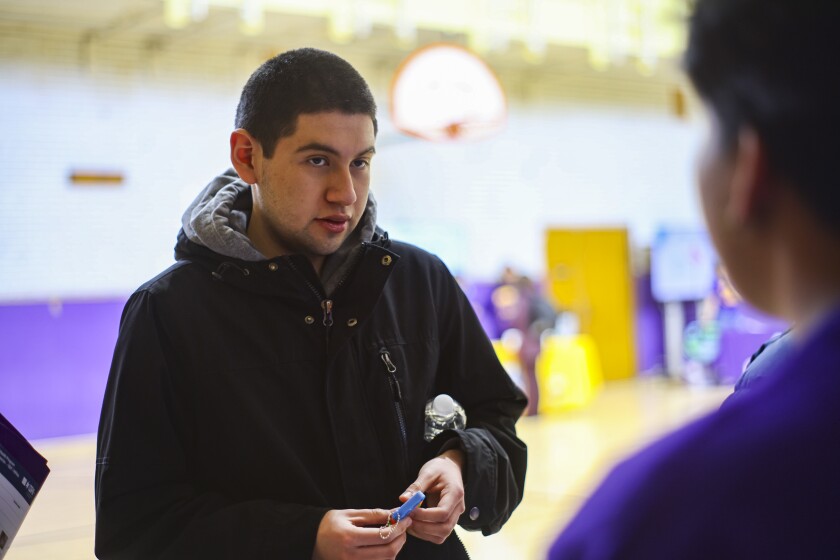
Looking around the gym at the welcome fair tables, Efrain said he is not really a “club-joining type of person,” but he would like to find a space at Schurz like the one he had at Aspira.
Senior Jonathan Escobar said some of his friends are also at Schurz, but it doesn’t feel the same walking the halls.
“My teachers, my classes, I miss everything,” Jonathan said. “It is sad to leave the old school I used to be at. It feels like coming to a new home.”
Mom Griselda Hermosillo said she and her daughter, Estefani Martin, a junior, feels welcomed at Schurz so far, and she’s hopeful that it will be a good place, emotionally, for her daughter. Estefani said it’s been a relief to see many of her Aspira friends in the hallways at Schurz.
But Hermosillo feels like someone should be held responsible for the abrupt closing of Aspira’s schools. She doesn’t understand why parents weren’t informed about the troubles sooner.
“Nobody is talking about it anymore and it feels like this period has passed and we are going to move on,” she said.
About the Author

Discover more from USA NEWS
Subscribe to get the latest posts sent to your email.


