
One man is credited with changing transportation in the early 1800s through bringing the steamboat to America and refining it.
AAR is proud to partner with WTOP to bring you this series.
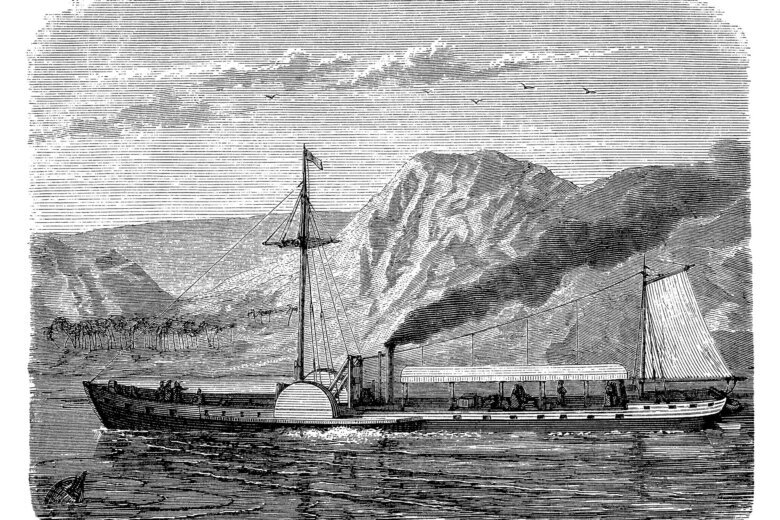
Steam engines have been around for more than 250 years. But in the U.S. — one man is credited with changing transportation in the early 1800s through bringing the steamboat to America and refining it.
“His name was Robert Fulton and he was from New York,” said Owen Lanier, the executive director of the Steamboat Era Museum in Irvington, Virginia. He said steamboats changed the world the way jet airplanes did in the 1950s and the internet revolutionized communication and commerce.
Fulton became interested in steam as a propulsion system when he was just 12 years old, in 1777, one year after the American Revolution. Even as a child, Fulton was transfixed on the idea of moving goods and services through the growing country in a series of canals.
By the time Fulton was in his early 30s, he had crossed the Atlantic numerous times. In 1800, he was in France working with the country’s leader, Napoleon Bonaparte, to design the first submarine. Fulton then designed the Nautilus, the first submarine.
While in Europe, Fulton worked with Robert Livingston, the U.S. Ambassador to France and the two collaborated on building a steamboat and operating it on the Seine. Early trials were mixed. One boat sank.
Fulton returned to the U.S. and in 1807, he and partner Livingston built the first commercially successful steamboat. The Clermont began carrying passengers up and down the Hudson River from Albany, New York, to New York City in a 150-nautical mile trip in 32 hours.
Society was changed forever.
“For everyone born between 1790 and the First World War, steamboats are essentially the cars you see on the road today and railroads. They are essentially the same thing,” said Lanier, noting that New York City became the financial capital of the U.S. in part because of its massive port, the Port of New York and New Jersey, which is still today one of the busiest in the world.
The steamboat’s mechanical motion is relatively simple. Wood, coal or oil are burned in a firebox. A water tank above the fire is heated, creating pressure and steam, which pushes pistons back and forth, connected to a drive shaft which rotates the paddle wheel.
Steamboats became so sophisticated, powerful and safe that by 1838, they could carry passengers and commerce across the Atlantic Ocean.
“You could get into a ship in New York City and because of steam power be in England across the Atlantic Ocean in just a matter of weeks.” said Lanier noting that steamboats, especially when the more modern propeller steamships of the mid to late 1800s became commonplace, cutting the time on an ocean voyage to as little as 12 days.
These ships were also much safer and could deal with the Atlantic’s unpredictable weather much better.
Get breaking news and daily headlines delivered to your email inbox by signing up here.
© 2026 WTOP. All Rights Reserved. This website is not intended for users located within the European Economic Area.
About the Author

Discover more from USA NEWS
Subscribe to get the latest posts sent to your email.


