
The Knives Out franchise has become something of an anomaly in modern cinema. In an era defined by superheroes and CGI-enhanced storytelling, director/writer Rian Johnson has created a franchise that is surprisingly familiar and old-fashioned, crafting a retro, Hitchcockian-inspired murder mystery that somehow still satisfies modern audiences’ TikTok attention span. He’s bound to do it again with the release of Wake Up Dead Man: A Knives Out Mystery.
For this third installment in the series, released exclusively on Netflix, Johnson and his trusted private investigator, Benoit Blanc, played by Daniel Craig, faced a unique challenge. After tackling the class struggle of an old-money family in the first Knives Out and the toxic culture of the tech elite in Glass Onion, where could Blanc go next? The answer lay in a theme arguably more historically explosive than any blockbuster action flick: religion.
“Can we make a movie that talks about faith as opposed to talking at it or finger-wagging or feeling didactic?” Johnson asks Newsweek in an interview alongside Craig and co-stars Josh O’Connor and Glenn Close. “But at the same time, that doesn’t pull any punches in terms of the conversation about both faith and religion and society. And can we do it? This is the bigger challenge in the context of a Benoit Blanc mystery, which is a big, fun, entertaining murder mystery that welcomes audiences into the big tent to have a good time with their families. And that seemed like an interesting challenge.”
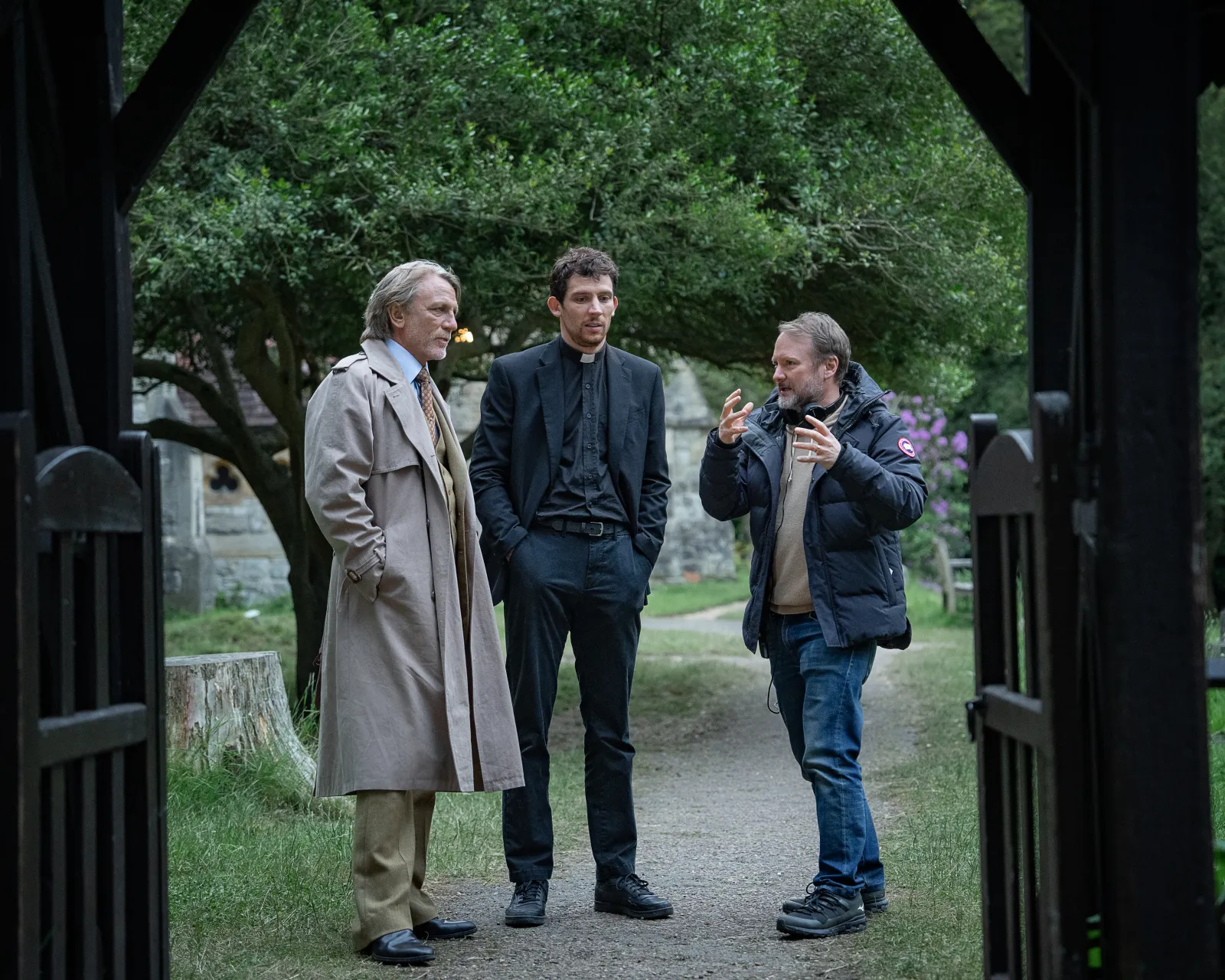
The film finds Blanc in a small community in upstate New York investigating the murder of Monsignor Jefferson Wicks (Josh Brolin). In one of Blanc’s most difficult “locked room” puzzles, Blanc finds himself teamed up with Father Jud Duplenticy (O’Connor)—a young priest caught between his vows and the truth—to navigate a group of church faithful whose spiritual devotion masks deadly secrets.
The challenge for this one was tonal as much as it was thematic. How do you introduce the weight of spirituality in a genre defined by humor, camp and wit? Therein lies the magic of Johnson’s work, and it shows in every performance, particularly those of Craig, O’Connor and Close. But for Craig, this thematic dance is exactly what has appealed to fans of the franchise, and it’s why they keep coming back.
“A lot of it is down to Rian’s attitude toward filmmaking,” Craig says. “He wants to give people the best time that they can have in a cinema. It’s not that much more complicated than that. And thankfully he’s picked this genre right now to do that.”
And for Craig, who has inhabited the Southern sleuth for three films now, that theatrical experience the audience receives is paramount.
“You have to come together as a group, and you’re putting on a show, and you should never really forget that, I don’t think,” he explains. “At the end of the day, it’s like, how can we please people? How can we turn them on?”
For Johnson, that spark to turn on an audience rarely comes from the murder itself; the “how” of the murder is secondary to the “why.” Settling on this story required Johnson to look past the puzzle he created and into his own personal story.
A Personal Compass
The pivot to faith wasn’t some random narrative dart throw for Johnson. It was personal.
“Well, it came first of all from Daniel and I having an initial conversation about how it would be nice to ground the next one a little bit more,” Johnson says. “And that led me to thinking, OK, so that means how do I make it personal? And that led me to making it about faith.”
The story is populated by characters grappling with their own relationships to devotion. From Close’s Martha Delacroix—the Monsignor’s most devoted worshipper and unofficial protector of the church—to the parade of church patrons who make up Johnson’s quirky world, including Kerry Washington as Vera Draven, Andrew Scott as Lee Ross and Jeremy Renner as Dr. Nat Sharp, among others. While Johnson doesn’t acknowledge this directly, it’s fair to assume each character’s own complicated relationship to the church mirrors his own relationship to faith.

“I didn’t grow up Catholic, but I grew up very Christian,” Johnson reveals. “I grew up a Protestant, kind of evangelical. And I’m not at all anymore, I’m not a believer anymore, but when I was growing up and into my early 20s, it was something that was a deeply personal, huge part of who I was and how I saw the world. So it’s something I have really strong and very complicated feelings about.”
The complicated feelings serve as the backbone of the plot, building the mystery around the uncertainty of belief itself.
“For me, it comes from setting the compass very early to the movie truly being about faith. And then once I start diving into the details of the script,” Johnson says, “even down to the details of the mystery and the murder, all of those things, I’m formulating [them] in order to be oriented around this center of the movie.”
But what does that mean for Blanc? For a character rooted in logic and reason, investigating a murder based on the uncertainty of faith proved to be a challenging opportunity to discover more about the detective.
“What I loved about this script was that we don’t get to know a lot more about him,” Craig says. “I like the mystery of him. But through his relationship with Father Jud Duplenticy, he has a revelation about the world. He has a mind-expanding moment, which, in any other person, it might be seen as a religious experience. He doesn’t see it as a religious experience; he sees it as a wonderful lesson learned.”
But, of course, it’s a Knives Out mystery, so there’s going to be humor.
“Young, dumb and full of Christ,” Johnson laughs, quoting a favorite line from the film. “I think growing up, especially as a teenager in the church, you laugh a lot about it. It’s not like a sacred cow, it’s actually part of your life you’re living with, and that means it’s something you’re laughing about also.”
The Heart of the Mystery
Central to Blanc’s “mind-expanding moment” is O’Connor’s Father Jud. Blanc might be the brains of the operation, but Father Jud is certainly the soul. That depth of emotion made O’Connor the perfect choice for Johnson and Craig.
“We both hit upon Josh it felt like at the same time,” Craig recalls. “His name came up, and it was like, ‘that’s the person we want.’ And we’re not used to not getting our own way. We’re spoiled.”
O’Connor, best known for his Emmy-winning performance of Prince Charles in Netflix’s The Crown, steps into the role of Father Jud with a surprising lightness. For O’Connor, the character offered him a chance to reframe what faith looks like on screen.
“I think that what Father Jud is exploring is this notion of uncertainty,” O’Connor says. “It doesn’t have to be fact or printed into stone. It’s like faith is a question. Faith requires a belief in change and forgiveness.”

What will be perhaps new to O’Connor fans is just how funny he is in Wake Up Dead Man. And for O’Connor, he jumped at the chance to use humor to show a greater depth of emotion, particularly because he long drew inspiration from actors like Gene Wilder and Pete Postlethwaite.
To O’Connor, humor is a trapdoor, a way to disarm the audience in order to deliver that emotional payload.
“It’s so great being able to create something that’s funny and humorous, and then also be able to dance that line between the humorous and the more profound or the more emotional,” he says.
“Some of my favorite comic performances really dance with an audience, and they acknowledge once they’ve got you laughing, you’re vulnerable and they can pull the rug from underneath you—and next thing you know, you’re having your heart broken.”
This ability to oscillate between the comedic and heartbreaking has earned O’Connor a comparison to a certain Hollywood legend from another Hollywood legend.
“I just think he’s like Jimmy Stewart,” Close says. “And what is it about Jimmy Stewart? You always feel that there’s a human heart there. And there’s somebody that you love. He’s easy to love. And that’s a beautiful quality to have, certainly in film. He’s empathetic and he’s sympathetic and real and unassuming and lovely, and he’s just a great guy.”
“I love Glenn’s comparison to Jimmy Stewart,” Johnson says. “I also think that, like Jimmy Stewart, Josh can do anything. Like Jimmy Stewart, you look at him in an Anthony Mann Western and look at him in It’s a Wonderful Life and there’s just a massive gamut. I mean Josh, when I saw him in Challengers, I was like, ‘Oh my God, who is this charismatic [person]?’ He just jumps off the screen.”
Craig agrees, noting the specific way O’Connor draws the viewer in. “He’s a brilliant, brilliant, brilliant actor, everything he does is believable. He’s also incredibly funny. I know he’s played lots of serious roles, but he’s just a lot of fun to have around.”
The Icon
While O’Connor may provide the heart, Close provides the gravity. When asked about what she brings to the film, Johnson sums it up perfectly.
“Well, I mean, I guess the short answer is, she’s Glenn motherf****** Close,” Johnson says.
Close’s Delacroix is shrouded in mystery. In order to find her character, the actor drew from a harrowing chapter of her own life.
“From 7 to 22, I was in a cult,” Close says matter-of-factly, referring to her childhood spent in Rev. Frank Buchman’s Moral Re-Armament, which believed war could be avoided through moral transformation by believers. “Not of my choice. I had no choice. And I think Martha is a woman who had no family life. She was the church, and the man who founded that church was her whole life. I can understand that mindset. So, I could totally commit to it.”
Despite this intense devotion to character, Johnson was struck by the joy Close brought to the set.
“Every day when she showed up on set, she was there with the energy of someone who had just gotten their first job in the industry,” Johnson recalls. “And by that I mean she loves making movies, and she shows up with almost like a wide-eyed wonder of, ‘We get to do this?’”
Craig found a kindred spirit in Close.
“We want the same things. We want to find the truth. We want to find the humanity in the people we’re playing. We want to make people laugh. We want [to] make people clap. We’re looking for love.”
One thing many fans of Close want for her is an Oscar and, based on the reception from critics of her performance in Wake Up Dead Man, that could be a very real possibility in the near future. While Close maintains that it’s always about the work, not awards, she admits the validation would be nice.
“To be in this profession for 50 years and still be in the room, that’s incredible,” Close says, “because it’s a brutal profession. But I’m now starting to say, it’d be nice. You know? It’d really be nice. Because I think it does change maybe how people within the business look at you. You want to get great parts. You want to get parts that give you a run for their money, your money.”
Keeping the Mystery Alive
Wake Up Dead Man is a carefully constructed puzzle built by a team that is genuinely having fun. And it’s that joyful team that is the real clue to the franchise’s success.
“They talk about, ‘Oh, we’re such an ensemble.’ And it’s not usually the truth,” Craig admits. “Genuinely on these movies, there’s just this feeling of coming together, because of this man [Johnson], and because of the scripts, because of what he and his attitude and joy that he brings to the set, it’s an incredibly creative process.”
And with Johnson and Craig at the helm, Blanc will continue to pull the wool over our eyes. The future of the franchise isn’t dictated by box office numbers, but rather the thrill of the unknown.
“Look, I feel like as long as we can keep figuring out new and slightly scary things to do,” Johnson concludes—“scary meaning, we don’t know if we can pull it off or not. ‘Gee, can this genre do this? Let’s find out.’ And as long we’re both enjoying it, as long [as] the audiences are into it, as long as this guy [Craig] wants to keep coming back, I’d be thrilled to keep making these for a long time to come.”
About the Author

Discover more from USA NEWS
Subscribe to get the latest posts sent to your email.


