
A firefighter has been killed and about 40 homes destroyed after fast-moving bushfires swept through communities in New South Wales (NSW) and Tasmania over the past few days, according to officials.
Authorities have warned that this summer’s fire season is only beginning, with more dangerous weather on the way.
The 59-year-old firefighter died on Sunday night after being struck by a falling tree while battling a blaze near Bulahdelah on the NSW Mid North Coast, according to the Associated Press and Australian Broadcasting Corporation (ABC).
In total, four homes have been lost at Bulahdelah and 16 at Koolewong on the NSW Central Coast, with another 19 destroyed in the small coastal community of Dolphin Sands on Tasmania’s east coast.
Why It Matters
The fires are an early test of Australia’s preparedness for another dangerous bushfire season, coming a few years after the catastrophic “Black Summer” of 2019-20. Prime Minister Anthony Albanese has warned that “this summer … is going to be a difficult one,” noting NSW in particular faces conditions ripe for serious fires.
Natural disaster declarations have already been issued for six local government areas in NSW—the Central Coast, Mid Coast, Upper Hunter, Muswellbrook, Warrumbungle and Dubbo—unlocking joint federal-state disaster recovery payments for residents, small businesses and primary producers.
In both states, the blazes have hit communities that are no strangers to fire but are again being pushed to the limit: Dolphin Sands residents told ABC that at least eight bushfires had broken out on the narrow peninsula—close to Tasmania’s iconic Wineglass Bay—in the past 15 years.
What To Know
Authorities say the weekend’s fires have torn through bushland and suburbs under searing heat, strong winds and rapidly changing conditions.
According to ABC, 20 homes have been confirmed destroyed in NSW: 16 at Koolewong on the Central Coast and four in the Crawford River area near Bulahdelah.
The Tasmania Fire Service has confirmed 19 homes lost at Dolphin Sands, with about 195 assets—including sheds, garages, vehicles and water tanks—damaged or destroyed.
The Bulahdelah fire has burned more than 3,000 hectares—the equivalent of 10 Central Parks—while the Dolphin Sands blaze scorched about 700 hectares of dry coastal scrub, according to the Tasmania Fire Service.
The firefighter who died was an NSW National Parks worker doing hazard-reduction work near the Bulahdelah fire, about 150 miles north of Sydney. ABC reported that about 60 fires were continuing to burn across NSW, with most of the weekend’s property losses on the Central Coast.
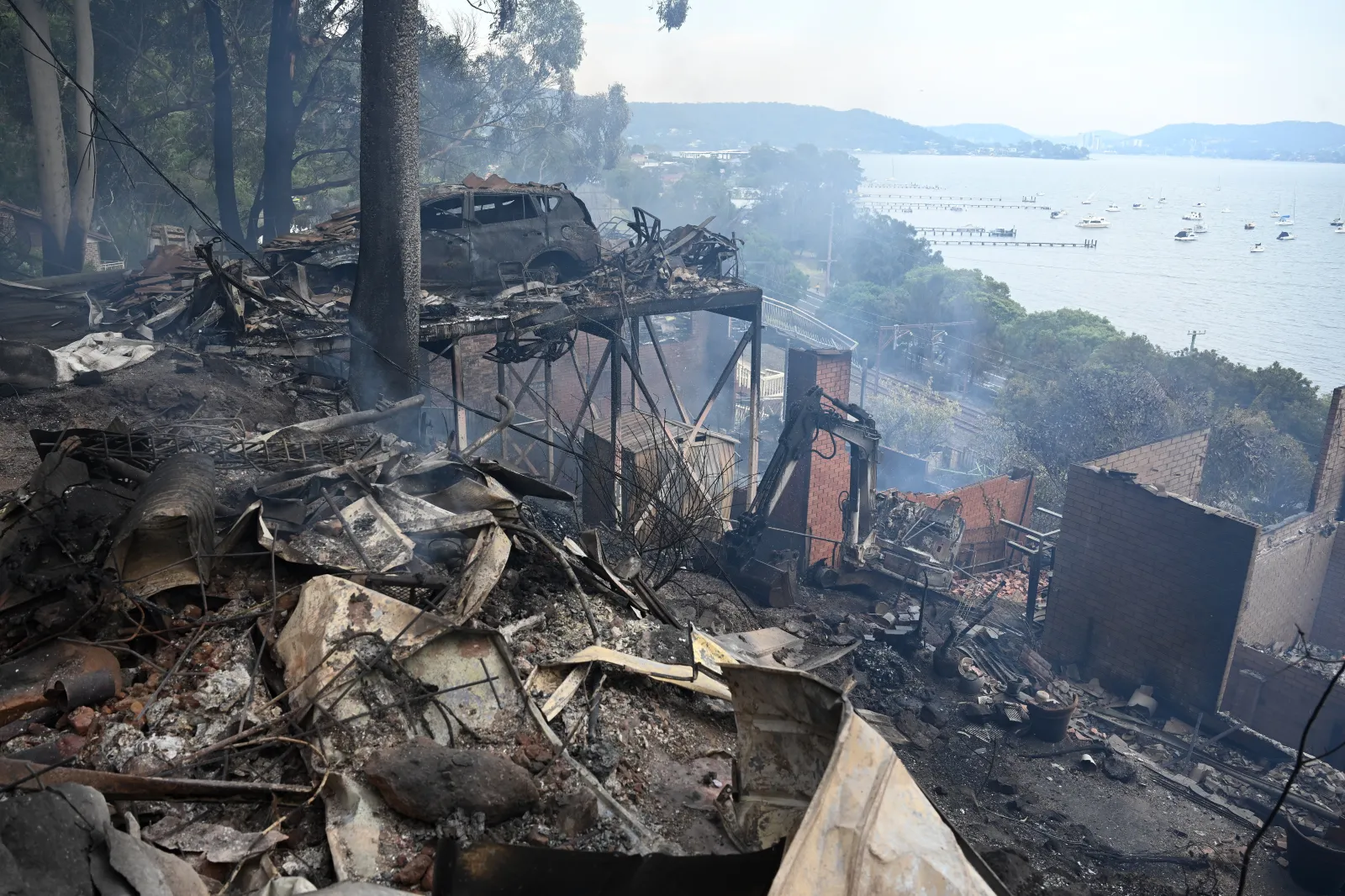
At Koolewong, in addition to the 16 houses destroyed, assessments by the NSW Rural Fire Service found nine damaged and 118 untouched, along with multiple outbuildings.
The Black Summer of 2019-20 in Australia was an unprecedented bushfire season from mid-2019 to early 2020, marked by extreme heat, drought and widespread, intense megafires, especially in the southeast, burning 18.9 million hectares—about the size of New York state—killing over 30 people, destroying thousands of homes, affecting 1 billion animals and causing billions in economic damage.
What People Are Saying
Claudia Stellino told the Australian Broadcasting Corporation that she and her husband lost their Koolewong home of 18 years in minutes as the fire roared through their street, adding: “My heart hurts.”
Her husband, Tony Stellino, said: “All the memories—we’ve lost everything.”
Commissioner Trent Curtin of the New South Wales Rural Fire Service said: “[The fire] moved very, very quickly into properties. We issued a Watch and Act and then it escalated very quickly to an emergency warning, and notified people by landline and by text message to warn them of that fire.”
NSW Premier Chris Minns, who met families at an evacuation center, said: “Our support crews, either at the evacuation centers through the RFS, will be working with affected families today directly.”
What Happens Next
While cooler conditions and some rain brought temporary relief to exhausted crews, authorities have warned that the danger is far from over. ABC reported that all fires in NSW were listed as under control by Sunday evening, but emergency services expect the number of damaged properties to rise as assessments continue.
Fire authorities in both states are urging residents to stay up to date on warnings, prepare bushfire survival plans and stay clear of exclusion zones so crews can continue strengthening containment lines, even as families who have already lost homes begin the long process of recovery and rebuilding in communities once again scarred by fire.
About the Author

Discover more from USA NEWS
Subscribe to get the latest posts sent to your email.


