
Narrative clarity is not the strength of the unique and wildly evocative “White Rooster,” a fanciful, fun, extremely theatrical mashup of ghost stories, Chinese folklore, the mythology of the American West, rock music, puppetry, expressive movement, earthy dark humor and dreamy illogic.
From the creative mind of writer/director Matthew C. Yee (the 2023 musical “Lucy and Charlie’s Honeymoon”) and receiving its world premiere at Lookingglass Theatre, “White Rooster” comes off as so energetic, well-performed and insistently intriguing that its sensual qualities provide an enjoyable vibe even if it never quite makes coherent sense.
Yee toys from the start with archetypes he filters through an oddball lens. The show seems set in an American, post-Gold-Rush era “ghost town.” That term has a double entendre here: Not only is the town defined by deprivation — the mines have long since been emptied and become unstable — but it is also literally populated with ghosts. The opening musical sequence — the show isn’t a musical, but frequent, partial songs, backed by electric guitar, serve as a form of third-person narration — informs us that “There’s ghosts in this town, they stop and say hi/But no one can tell if they’re dead or alive.”
Throughout, Yee allows the characters to acknowledge the combination of the literal and the fantastic in a humorously self-conscious way. “Are you a ghost?” asks lead ingenue Min (Sunnie Eraso) in the opening scene of the woman June (Noelle Oh) living in her attic, followed by “Sorry. Can I ask that? Is that rude?”
In the core narrative, Min falls for a young man named Pong (Reilly Oh), who then, along with Min’s father, John, (Mark Montgomery) dies in a mine collapse. Pong’s grandparents (Louise Lamson and Daniel Lee Smith) suggest Min marry Pong — “Unmarried and dead. Bad combo. Ask anyone,” explains the caring and wise granddad.
Yee has discussed that the play was inspired by his own family history of such a Chinese “ghost marriage,” with the spirit of the dead spouse represented physically by a white rooster. So yes, Min marries a rooster. “You may kiss the bird,” says the highly quirky holy man (Elliot Esquivel), pointing to the puppet title fowl at the culmination of the wedding.
But any foregrounded storytelling here competes for attention with a series of background stories that pile up. Characters, such as Min’s mother (Karen Aldridge), gleefully grind any forward action to a halt to tell another poetically creepy story, such as a miner who couldn’t stop digging until the mountain rebelled, a town bedeviled by a drought demon and zombies, a man whose pet pig eats gold, etc.
These tales are told through a mix of shadow and physical puppetry. Puppet designer Caitlin McLeod’s excellent work defines much of the world, along with a bare wooden-plank floor and configurable, appropriately ghostly white curtains dominating Natsu Onoda Power’s set, and eclectic costumes from Mara Blumenfeld that suggest period but with a heavy tilt toward the bohemian chic.
Like so many actors who start to write and direct, Yee has created a show where performers can shine, and the cast here certainly does. There’s a wonderful natural present-ness that the actors bring to the weirdness of this world that lets the audience settle in. Although all have extremely enjoyable moments, Aldridge, Esquivel and Smith are provided with the most opportunity to exaggerate entertainingly in a way that still feels grounded in the work’s strange reality.
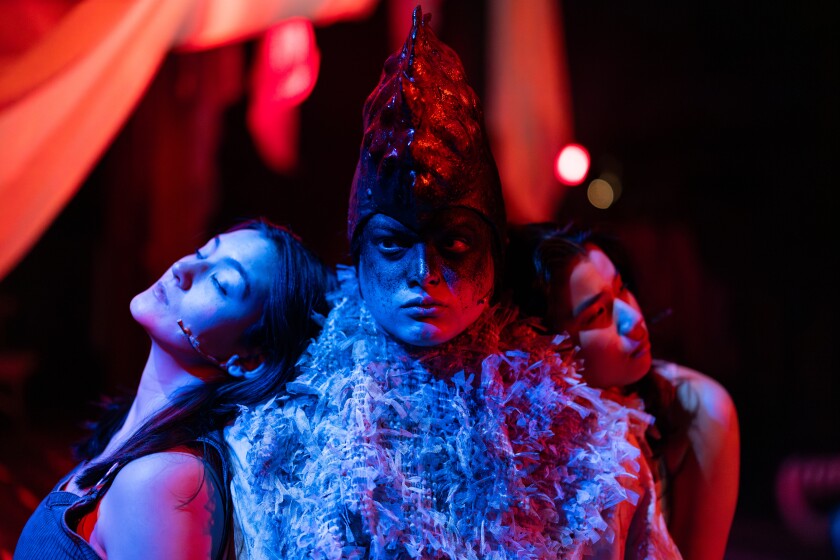
Yee starts to merge the present story with all the background ghost stories, to the point that characters even change names. It can certainly be hard to follow, and in truth, I’m still puzzled over whether its surreality has a meaningful logic underneath it.
And it’s certainly fair to ask what it all means. I appreciate the fact that there is no moral here — this is not an Aesop-style fable with a lesson to be learned. But its obsessions ring true in the way that abstract stories do — it’s about people who dream and strive and fail and grieve and struggle to understand, and how both the past and the imagination constantly impede the present so-called reality. Yee’s mix of Asian and American genres here, and the willingness to take none of them too seriously, expresses an embrace of multiple storytelling traditions while also seeking some deeply personal way of explaining the world.
Pruning and sharpening should most certainly continue on “White Rooster,” but this type of ambitious artistic endeavor deserves all sorts of encouragement no matter how messy its current state.
About the Author

Discover more from USA NEWS
Subscribe to get the latest posts sent to your email.


