
Real Estate
With the possibility of more snow this weekend, it’s important to get your house ready.
As the Boston area digs out from last weekend’s wallop of snow, the forecasts say more snow could be on the way. This storm is predicted to be lighter than the last — or may not hit at all. “What I can say now is that the most likely areas to see significant snow will be Cape Cod, the Islands, and perhaps Southeastern Massachusetts, with lighter amounts possible for Greater Boston,” meteorologist David Epstein wrote for the Globe.
Just in case, we thought we would offer a few tips to prepare your house for more snow.
Shovel around vents and heat pumps
As always, safety first. So many homes now have high efficiency sealed combustion boilers and furnaces that do not vent out through the chimney at rooftop height. These units typically will have their intake and exhaust going out through the side of the house. These do need to be high enough off the ground to allow for typical snow patterns, but snow drifts due to high winds can pile pretty high, and this next storm is coming with very high winds. For that reason, it is so important to shovel out the areas around the flue and intake vents and watch them as a storm progresses. Not doing so could lead to dangerous carbon monoxide backing up into the house.
Electric heat pumps are being installed in almost all our residential remodels. There are no dangerous flue gases that can back up with a heat pump but you still need them to be clear of ice and snow. If properly installed, the outside condenser will be on a stand perhaps 16 inches off the ground. The same issue with snow drifts can bury the condenser and cause it to shut down. For the same reasons as with sealed combustion, it is important to keep the condensers clear and watch them as the snow piles up.
Keep gas generators outside
If you use a portable gas generator for power outages, keep those well away from the house and any windows. Do not put one in the garage and have it running, these will also produce dangerous carbon monoxide build up inside the house. Also, make sure your smoke and CO detectors are working properly.
Keep exits clear in case of emergency
Keeping all means of egress clear in the event of a fire is another safety issue that is sometimes forgotten. We often just want to get the front door, walkway and sidewalk cleared so we can get on with our lives. The secondary back door or basement door need to be cleared as well, especially if there is a storm door that opens out — which most do. Having a 3-4-foot snow drift piled up against the storm door will make it impossible to get out in an emergency.

Prevent ice dams on the roof
For those of you who have a roof rake and the ability to clear at least the first 3 feet of the roof line, it is critical to do that as soon as possible. Preventing those ice dams from building up is not something you do the next day or the day after. I would argue that you clear the edge of the roof before you worry about your driveway. Once an ice dam forms at the bottom edge of your roof, it is too late to rake it clear. You can minimize the damage by continuous raking but inevitably the melting will get backed up and make its way into the house.
Tips for when the snow melts
The good news is that eventually all this snow will melt. The bad news is that all this snow will melt. That’s where more problems can start. Here are a few tips for the inevitable melting event — hopefully it’s a slow melt.
Keep basement window wells clear
With winters like this, the window well gets completely full of snow and when that melts, it can easily get past a window, which is essentially a big breach of your foundation wall.
Clear gutters
We advise clients to pay attention to your downspouts that discharge water out of you gutter system. Keeping those clear when the big melt comes can save a lot of aggravation when an entire gutter system backs up. If possible, add an extension onto the downspout so water is pulled away from the foundation.
Consider a sump pump
A French drain system is typically not a viable solution to capturing high water tables during a melting event unless it is part of a basement remodel. A more practical solution is to install a single sump pump buried into the floor that will pick up the rising water tables and discharge it to the outside. Water usually rises at a uniform rate around the perimeter of the house so even a sump pump in the utility area can keep water from getting up into a more finished part of your basement. If even that is not practical, have a submersible sump pump at the ready that can be put onto the basement floor. These will have a garden hose attachment that can be run to the outside of the house.
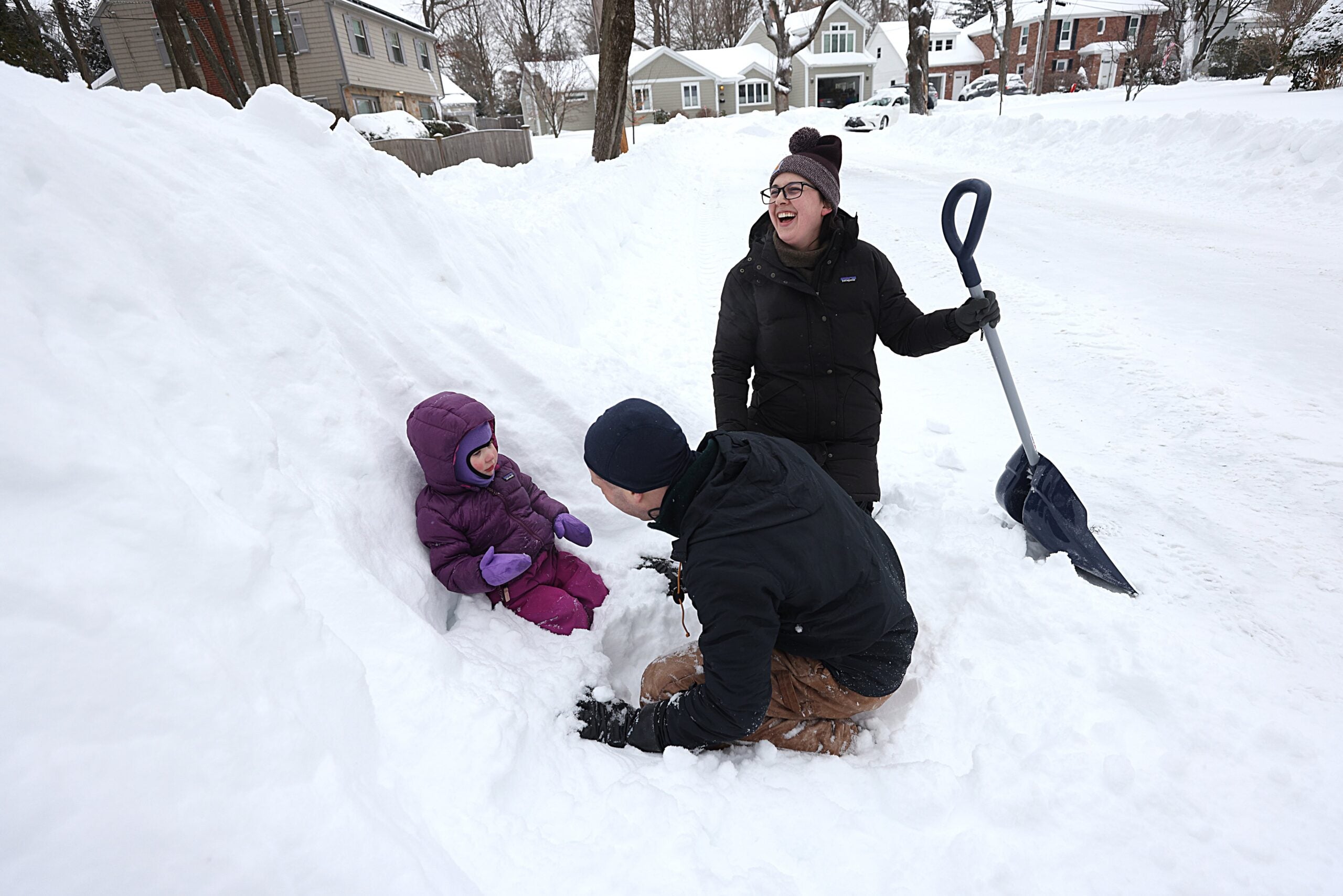
– Suzanne Kreiter/Globe Staff
Good luck with the next storm!
Mark Philben is the project development manager at Charlie Allen Renovations in Cambridge. Send your questions to [email protected]. Questions are subject to editing. Subscribe to the Globe’s free real estate newsletter — our weekly digest on buying, selling, and design — at Boston.com/address-newsletter.
Address Newsletter
Our weekly digest on buying, selling, and design, with expert advice and insider neighborhood knowledge.
    !function(f,b,e,v,n,t,s)
    {if(f.fbq)return;n=f.fbq=function(){n.callMethod?
    n.callMethod.apply(n,arguments):n.queue.push(arguments)};
    if(!f._fbq)f._fbq=n;n.push=n;n.loaded=!0;n.version='2.0';
    n.queue=[];t=b.createElement(e);t.async=!0;
    t.src=v;s=b.getElementsByTagName(e)[0];
    s.parentNode.insertBefore(t,s)}(window, document,'script',
    'https://connect.facebook.net/en_US/fbevents.js');
                const onetrustStorageConsent = JSON.parse(localStorage.getItem( 'consent_one_trust_bdc' ) );
        if ( ( onetrustStorageConsent !== null ) ) {
            /* The above code is parsing the JSON data from the local storage and storing it in a variable.
             * Checking if the user has given consent for the cookie C0004.
             * If the user has given consent, the variable consent will be set to 'grant'.
             * If the user has not given consent,the variable consent will be set to 'revoke'.
             * Documentation https://developers.facebook.com/docs/meta-pixel/implementation/gdpr
            */
            if ( onetrustStorageConsent.C0004 !== true ) {
                fbq('consent', 'revoke');
                fbq('dataProcessingOptions', []);
            } else {
                fbq('consent', 'grant');
                fbq('dataProcessingOptions', ['LDU'], 0, 0);
            }
        }
            fbq('init', '989222871864976');
    fbq('track', 'PageView');


    !function(f,b,e,v,n,t,s){if(f.fbq)return;n=f.fbq=function()
    {n.callMethod? n.callMethod.apply(n,arguments):n.queue.push(arguments)}
    ;if(!f._fbq)f._fbq=n;
    n.push=n;n.loaded=!0;n.version='2.0';n.queue=[];t=b.createElement(e);t.async=!0;
    t.src=v;s=b.getElementsByTagName(e)[0];s.parentNode.insertBefore(t,s)}(window,
    document,'script','https://connect.facebook.net/en_US/fbevents.js');
                const onetrustStorageConsent = JSON.parse(localStorage.getItem( 'consent_one_trust_bdc' ) );
        /* The above code is parsing the JSON data from the local storage and storing it in a variable.
         * Checking if the user has given consent for the cookie C0004.
         * If the user has given consent, the variable consent will be set to 'grant'.
         * If the user has not given consent,the variable consent will be set to 'revoke'.
         * Documentation https://developers.facebook.com/docs/meta-pixel/implementation/gdpr
        */
        if ( ( onetrustStorageConsent !== null ) && (onetrustStorageConsent.C0004 !== true ) ) {
            fbq('consent', 'revoke');
            fbq('dataProcessingOptions', []);
        } else {
            fbq('consent', 'grant');
            fbq('dataProcessingOptions', ['LDU'], 0, 0);
        }
            fbq('init', '813236348753005');
    fbq('track', 'PageView');
About the Author

Discover more from USA NEWS
Subscribe to get the latest posts sent to your email.


