
When Maddie Squire joined TikTok in 2021, she hoped to build an audience by posting her outfits and day-in-the-life videos as a junior in college. What she didn’t expect was to lean on that community after receiving a life-altering diagnosis at just 25 years old.
Originally from New York, Squire moved to Boston after graduating from college, and shared all of the typical happenings of a twenty-something with her TikTok followers: happy hours with her girlfriends, date nights with her boyfriend and lots of outfits.
In April 2025, Squire noticed some atypical dry skin around one of her nipples. That prompted her to do a self-breast exam where she discovered a lump, and she quickly made an appointment with a radiologist who conducted a biopsy.
Two days after that biopsy, Squire was celebrating her best friend’s law school graduation when she noticed three missed calls from her hospital. Before calling back, she checked her email to find a new test result had come in: “detected invasive ductal carcinoma.” A quick Google search confirmed: She had breast cancer.
“It was all so, so quick,” Squire said about the few weeks after her diagnosis, which included meeting with her new oncologist and scheduling a double mastectomy surgery for only two weeks later. She recalled thinking, “This is just such a big, life changing diagnosis that I might just want to keep to myself.” And for the next few weeks, she did — going dark on TikTok.
But then she gave it a second thought.
“I was like, ‘Wait, I love this. I love posting my outfits. I love sharing my stories,’” Squire said. “I also found a lot of other lovely women who were diagnosed with breast cancer super young, and I really enjoyed watching their videos.”
“It was comforting, seeing that they had done the same chemo as me or had the same surgery — but they also still would get dinner with their friends and everything,” she said. “When I first got diagnosed, it was really important to me that my life would still feel like mine.”
Squire returned to TikTok with a sit-down video sharing her detection and diagnosis story. She was greeted with hundreds of comments of support from her existing audience, as well as a slew of new followers.
“Queen you got this!! i just finished treatment from stage 2 idc, chemo, mastectomy, radiation the whole kit and kaboodle YOU’LL DO AMAZING here if you have any questions,” @alannavizzoni wrote on TikTok.
“Silent follower for years but sending so much love and health your way 🩷” another follower, @miapasta, commented.
Squire’s diagnosis had been completely unexpected. At her age and with no family history of breast cancer, she says even her radiologist initially had no alarms.
Her diagnosis reflects a growing number of breast cancer diagnoses in young women made in recent years. An August 2025 report from the Centers for Disease Control and Prevention found that the incidence of breast cancer among women in the U.S. below age 45 increased an average of 0.7% per year from 2001 to 2022. Several young celebrities have shared their experience with breast cancer in the past year, from 37-year-old singer Jessie J to former Bachelorette Katie Thurston who is 34.
The CDC says that breast cancer deaths have gone down, suggesting that with proper detection and treatment, a full recovery is possible for many women. However, some studies suggest discrepancies when it comes to the types of breast tumors young women more often are diagnosed with, and how those tumors may affect reoccurrence and long-term survival.
Scrolling through Squire’s TikTok content from the past eleven months of her cancer journey, it’s evident that maintaining the life of a typical twenty-something through treatment was a priority for her. While she frequently gives treatment updates and references her breast cancer, she’s more often seen simply showing her outfits before heading out for an errand or a meal with family and friends — something she says has helped her fight the initial fear of losing her identity to her diagnosis.
After her mastectomy, a biopsy of her lymph nodes revealed that Squire’s cancer had spread, meaning chemotherapy was necessary. Six weeks later, she went for her first treatment.
“I had such a mental block about [chemotherapy]” she said, a struggle she often got candid about with her followers.
“The one part that I knew I was going to struggle with, and I did really struggle with, was the hair loss,” Squire said. She did cold capping (a scalp treatment meant to slow down hair loss that chemotherapy drugs cause) but her type of chemo ultimately caused her to lose around 70% of her hair.
“Losing your eyebrows and eyelashes, your face just changes so much,” she said. “It sounds so vain to have that affect you, but as women, we have so much pressure on our appearance, it’s kind of hard to ignore. I’d look in the mirror and not recognize myself.”
Courtesy Maddie Squire
Courtesy Maddie Squire
Followers and commenters often praise Squire for her positivity and openness through her cancer battle and changing appearance. Rather than shy away from talking about her hair loss, she used it as an opportunity to incorporate chic vintage headscarves and wigs into her daily outfit videos, bringing followers along as she adapted her style.
“In my lowest moments, I’m always like, ‘Oh, at least I can put on a good outfit,’” Squire said. “Even if I’m literally grabbing a coffee, and then taking a nap, it makes me feel so much better to feel stylish and wear an outfit that’s comfortable and cool. It was a way for me to think positively about my appearance that wasn’t so tied to all the changes from chemo or my mastectomy.”
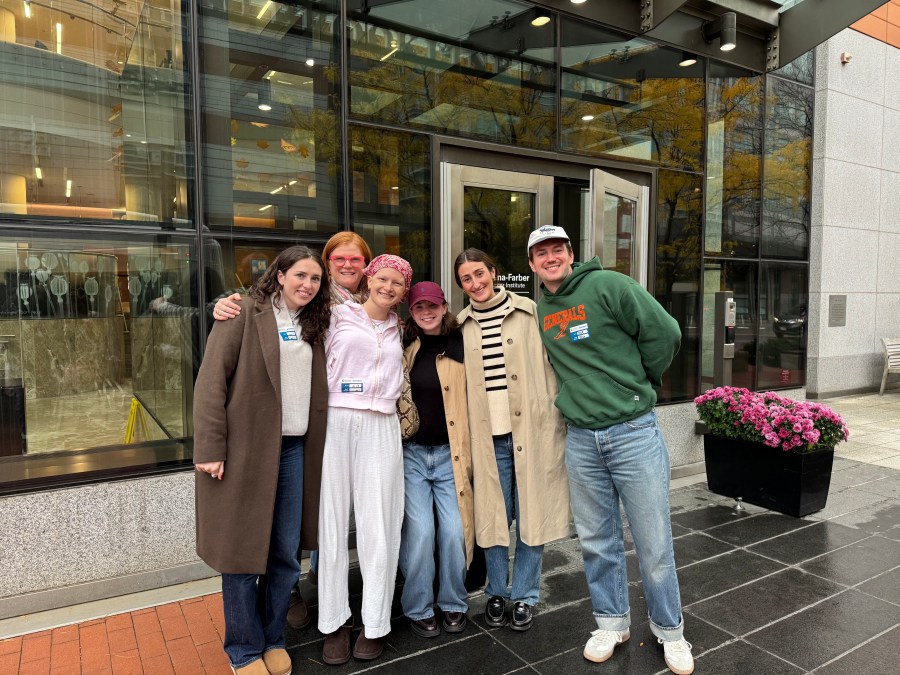
In October, Squire finished chemotherapy. For most of her treatments, she was joined by her mom and boyfriend at the hospital. But for her final day of chemo, her best friends from college traveled in to celebrate alongside her.
“I didn’t have any expectations of anyone in my life to come, period. Cancer is such a weird process,” Squire said. “But they took the train and came, just for the day. It was so fun because I love my nurses so much … so they got to meet all the people who’d been taking care of me.”
Squire also happened to finish up chemo during Breast Cancer Awareness Month, a coincidence she said she doesn’t take lightly.
“I’m so glad to close that chapter in October,” she said.
Squire’s treatment isn’t over — she’s had to do 16 rounds of radiation therapy since finishing chemo, as well as start hormone therapy (a common part of treatment for prevention after hormone-receptor positive breast cancer) which she’ll continue for five years. Now 26, she shared on TikTok in December that one of the harder parts of her cancer journey post-chemo has been realizing that she will be “forever changed by this.”
Despite young women making up a significant number of breast cancer diagnoses and mammograms being largely considered the most effective screening tool today, there are still no screening guidelines for women under 40, making it all the more important to be vigilant like Squire was. The symptom that prompted her initial concern, dry skin around one of her nipples, was something she easily could have ignored, delaying her early detection.
The National Breast Cancer Foundation recommends young women practice “breast self-awareness” — becoming familiar with how your breasts look so that you’ll notice any concerning changes and report them to your healthcare provider. According to a study published in the National Institute of Health’s National Library of Medicine, detection time has shown to correlate with survival outcomes.
As she continues to document her cancer journey and remission through TikTok, Squire finds her little corner of social media to be a consistent pick-me-up – her almost 50,000 followers serving as a pocket of online positivity at a time when social media typically fuels the opposite. Her audience, who often expresses admiration for her positivity through tough times, doesn’t hesitate to give that energy right back.
“It’s rare that you see so much positivity on TikTok,” Squire said of her audience. “I’ve just been so surprised by how lovely everyone’s been. It’s so sweet.”
Dr. Arif Kamal, chief patient officer at the American Cancer Society, explains how doctors assess a patient’s risk for breast cancer.
About the Author

Discover more from USA NEWS
Subscribe to get the latest posts sent to your email.


