
Olivet Baptist Church is Bronzeville’s oldest African American Baptist church and the second oldest African American congregation in the city.
The walls of the church tell a story of rebirth, not just for itself but for the neighborhood.
This year, the church community hopes to present plans to the Chicago City Council for a mixed-use affordable housing development on property the church already owns.
“This isn’t the first time Olivet has provided housing for the community,” said Pastor John L. Smith, the ninth pastor of the congregation, which has been worshipping in Bronzeville since 1918.
The church structure, in need to renovations and repairs of its own, was built in the late 19th century.
In 1919, the church’s leadership sought to quell violence during the Chicago Race Riots. It was also a place of sanctuary for thousands during the Great Migration from the south.
“If you had come from the south to the north and you were coming through Chicago, you could come to this church and have your employment needs met, have yourself connected with your family and your people but also housing. You could even have your educational needs met,” Smith said.
Olivet Baptist was the site of the community’s first kindergarten.
“So when we thought about what we can do and what are the needs of our community, it’s kind of a fast-forward from the past,” Smith said.
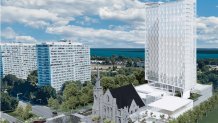
He walked alongside congregation member Irene Napier and Deacon Arnold Romeo in the church’s back parking lot, the planned site of a high-rise apartment building; a central part of the development project called Trinity Square.
Smith says the project, still in its very early stages, would address an affordable housing shortage that’s been brewing for decades.
“They tore down a lot of the high rises that were in our community, Ida b. Wells, Robert Taylor homes. And when those were torn down it displaced a lot of people,” he said.
Affordable housing policy expert Prof. Jeff Leslie with the University of Chicago says the city needs more projects like this, and hopes it comes to fruition. He notes that the city is short approximately 100,000 units.
“And in Bronzeville prices have really skyrocketed. They’re up 200 percent since the year 2000. And up 12 precent in the last year alone,” Leslie told NBC Chicago.
According to Leslie, around 60 percent of renters in Bronzeville are considered “rent-burdened,” meaning they spend more than 30 percent of their income on housing costs.
The $157 million development could include 366 mostly affordable housing units, with about 20 percent of the units going at what’s called “market rate,” meaning the cost of rent is determined by supply and demand of the market as opposed to affordable housing units.
Pastor Smith said they are seeking to acquire 10 percent of the $157 million through grants and other partnerships.
“Having some market rate units will help the financial viability of the project,” Leslie said. “But we know for projects like this it’s going to need a lot of subsidy and it’s probably going to need an allocation of low income housing tax credits which is a primary federal source for funding affordable housing.”
It’s a competitive and technical process, he said, which often requires developers with a track record of navigating it.
The church is working with Crossing Capital Group based in New Jersey to raise funds.
Pastor Smith eyes Atlanta as an example of a city where faith-based housing has benefited the larger community. He’d like to lead the way in Chicago.
“A lot of our churches have valuable property and a lot of it. And one of the ways we can revitalize that property and renew that property is to partner with our city or our civil institutions to create affordable housing on the land that the churches already occupy and own,” Smith said. “We might not be able to provide 100,000 units of housing. But we definitely can use what we have to contribute to the solution.”
Irene Napier, who joined Olivet Baptist as a young girl in the early 1950s, hopes to be one of the first residents of Trinity Square. She envisions something on the fifth floor, facing east.
As a congregation member of more than 70 years, she’s seen firsthand how the church reached past its doors to give people throughout Bronzeville opportunities.
“It was overwhelming for me. I was youngster. Coming to Chicago from Mississippi,” she said, where and her mother arrived to meet her five siblings already in Chicago.
“I walked into this building and it was a feeling that I still can feel today. The feeling of peace and joy.”
Napier went on to work as a nurse in Chicago and also served as a Deaconess at the church.
Today, the exterior of the church shows its age, with visible signs of disrepair and needed maintenance.
The structure landed on Preservation Chicago’s “7 Most Endangered” list in 2025. It is currently not recognized as a historic landmark by either the City of Chicago or the National Park Service.
Deacon Arnold Romeo has been a congregation member for more than 30 years. Trinity Square is a lofty goal, but he said it’s when, not “if.”
“We’ve been holding on and believing in faith and in God that he will give us a direction for restoration of our church,” Romeo said. “This is the legacy of African descendant people. This spot, this building,” he said.
The first part of that restoration, just completed; a new roof for the church’s sanctuary. Since 2019, Sunday services have been in the overflow room.
Pastor Smith says they are planning to submit concrete plans to city council sometime this year.
About the Author

Discover more from USA NEWS
Subscribe to get the latest posts sent to your email.


