
In 1938, NBC wanted to build the home of the future in Bethesda, Maryland. Ninety years later, it’s still standing.
The house, with its white-painted brick and unique geometric outline, sits on Massachusetts Avenue, just steps away from the D.C. line.
WRC
WRC
Fourteen years ago, when Rado Ivanov and his wife bought the house, the couple had no idea of the house’s history.
“We had no idea,” Ivanov said.
That’s until their neighbors, a couple from across the street, told them of the house’s historic beginnings.
“They said, well, ‘did you guys know about the history of the house?’ And we were like ‘no, but we love it,’” Ivanov said.
“It’s like, ‘no, this was the house of the future. It was built by the electric company to show that fully electric houses were possible.’ And that’s how we started digging around,” he said.
Ivanov’s digging led him to a Washington Art Deco book that featured the house.
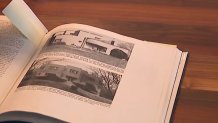
“And it’s one of the few Art Deco houses in the Bethesda area,” he said, referring to a style of architecture popularized during the early 20th century.
NBC, the very network associated with News4, partnered with a builder in 1938 to build the fully electric house of the future. That same year, on October 1, the house opened to the public.
Thirty thousand people lined up to look inside.
An architect himself, Ivanov walked News4 through his once futuristic abode, explaining what made the house so groundbreaking for its time.
At the time the house was built, wooden structures were much more common for houses, with the exception of perhaps a concrete basement. Ivanov pointed out the concrete walls and floors made of steel beams and concrete slabs.
“And that goes all the way through the entire structure of the building,” he said.
Ivanov says using such materials to make up the entire structure of the house was uncommon at the time of its construction.
Glass bricks may likewise be more common today, but they were popularized by the Art Deco movement — and in the 1930s, they were uncommon.
The same goes for the open staircase in Ivanov’s home.
“The stair was fully open, and connects all three floors of the house,” Ivanov said. “The stair [was] also fully built out of concrete. That’s not a wood stair. And it just creates that single open space experience that was uncommon at the time,” Ivanov said.
The ‘Cow House’
While Ivanov’s home makes for interesting conversation, most friends and passersby know his house by something completely different — a cow.
“It was built as the house of the future, but to us, and to our friends, the famous feature of the house is the cow that we have in the front yard,” he said. “Because everybody knows it as the house with the cow rather than the first electrified house.”
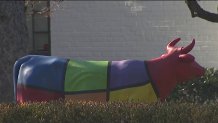
The cow’s fame led Ivanov’s house to be dubbed The Cow House.
“Maybe late 90s there was this whole city-wide story with the donkeys and the elephants and then they got auctioned out and all this,” he said, referring to the D.C. Commission on the Arts and Humanities ‘Party Animals’ project.
“To us, we looked at a few of those that were for sale and it was too much of a political statement,” Ivanov said.
While on a work trip in Texas, Ivanov says his wife drove past a strangely still cow on the side of the road.
“As she got closer, they were actually sculptures of cows. They weren’t real cows. And that gave us the idea of us having to look into cows instead of donkeys or elephants,” he said.
Though 30,000 people lined up to see the house of the future 90 years ago, Ivanov estimates way more people stop by today to see The Cow House.
“People ride it, people take pictures all the time, kids are there all the time,” Ivanov said. “We don’t mind. It’s totally fine,” Ivanov said.
Over the years, the house and cow have changed a bit. With Ivanov installing gas heat, the house is no longer fully electric. The cow, on the other hand, has changed colors and design.
It also sustained some damage one New Year’s Eve, when local kids went out cow-tipping.
About the Author

Discover more from USA NEWS
Subscribe to get the latest posts sent to your email.


