
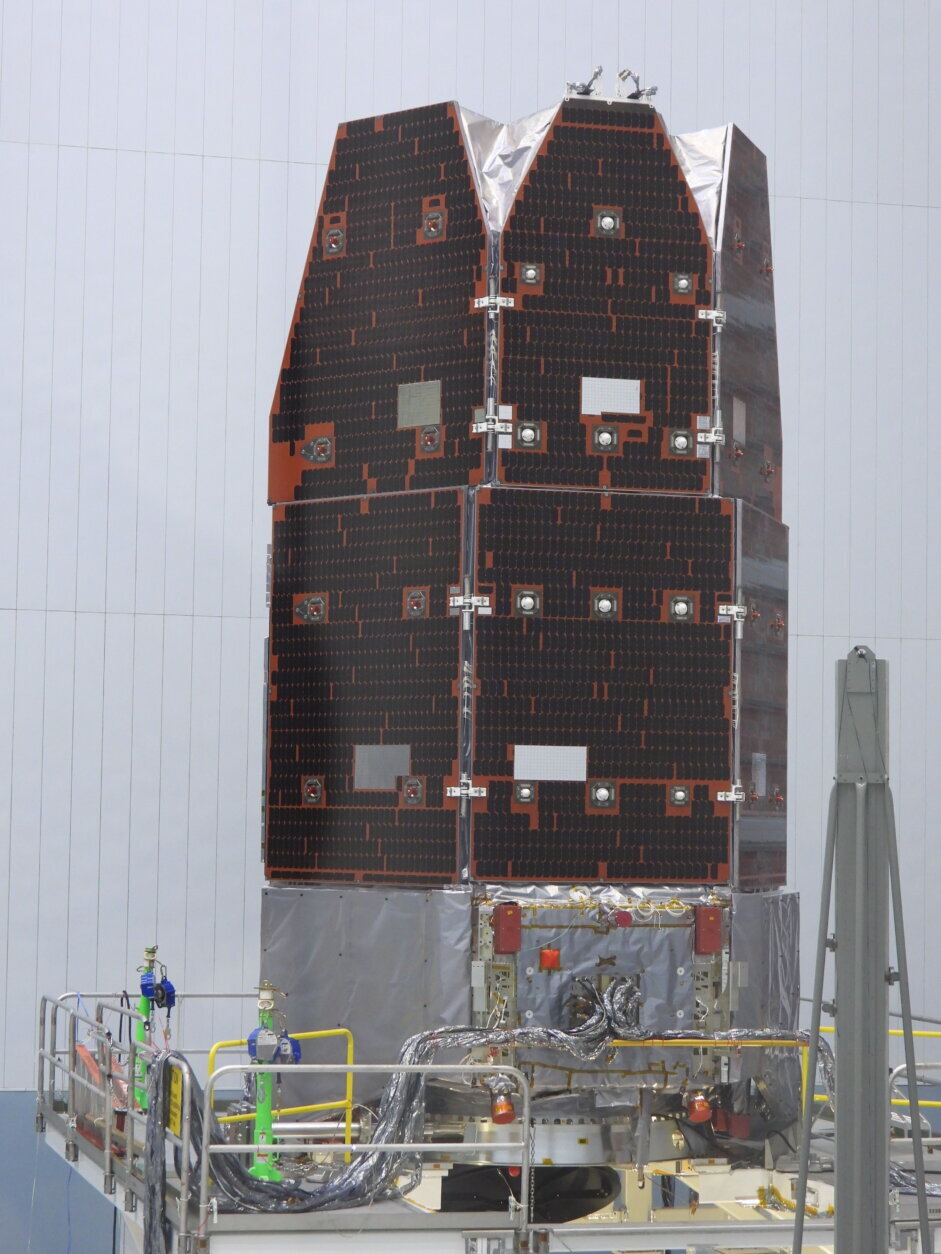
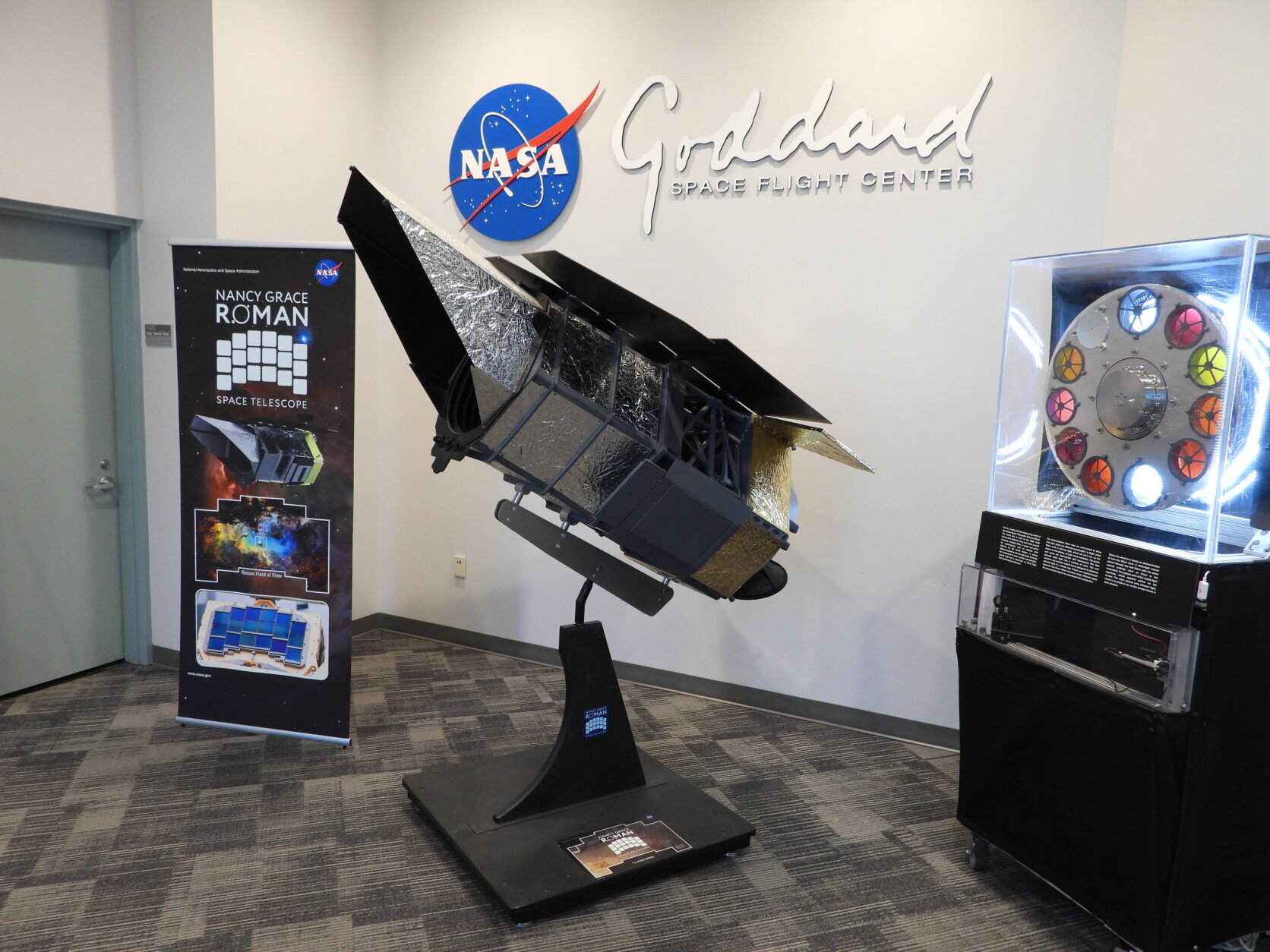
Next week, the NASA Goddard Space Flight Center will be unveiling its newest space telescope: the Nancy Grace Roman Space Telescope.
(WTOP/Greg Redfern)
(WTOP/Greg Redfern)
(WTOP/Greg Redfern)
(WTOP/Greg Redfern)
(WTOP/Greg Redfern)
Next week, the NASA Goddard Space Flight Center will be unveiling its newest space telescope: the Nancy Grace Roman Space Telescope.
The Roman telescope was originally called the Wide Field Infrared Survey Telescope (WFIRST) when NASA announced the project in February 2016.
NASA said in May 2020 it was “naming its next-generation space telescope currently under development, the Wide Field Infrared Survey Telescope (WFIRST), in honor of Nancy Grace Roman, NASA’s first chief astronomer, who paved the way for space telescopes focused on the broader universe.”
Roman is considered the “mother” of NASA’s Hubble Space Telescope, which launched into space with the Space Shuttle Discovery in April 1990.
Delivered to Goddard in November 2024, the Optical Telescope Assembly, which includes a 7.9-foot (2.4-meter) primary mirror, nine additional mirrors and supporting structures and electronics, was designed and built by L3Harris Technologies in Rochester, New York.
“The assembly incorporates key optics (including the primary mirror) that were made available to NASA by the National Reconnaissance Office. The team at L3Harris then reshaped the mirror and built upon the inherited hardware to ensure it would meet Roman’s specifications for expansive, sensitive infrared observations,” NASA said in 2024.
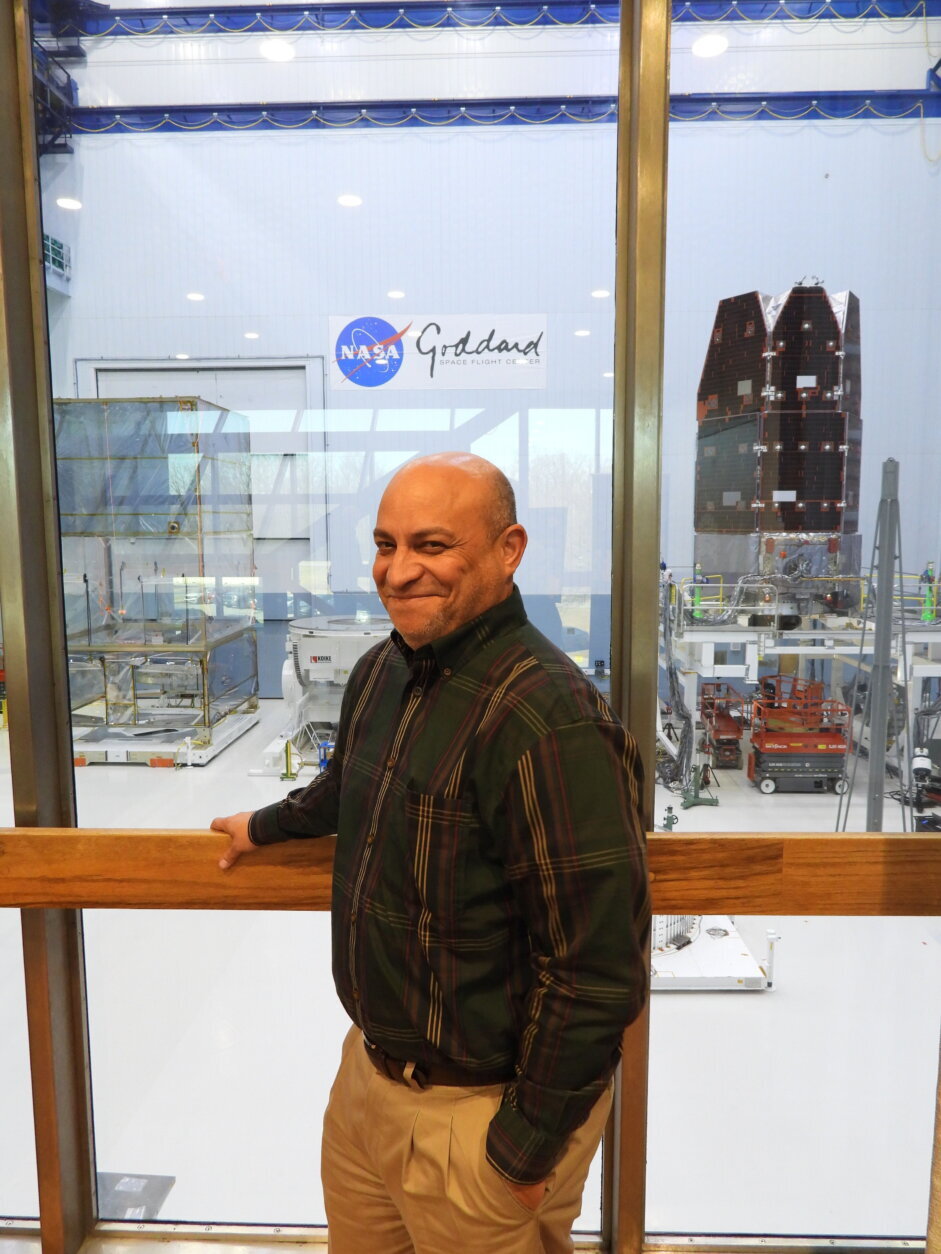
I had the opportunity to visit Goddard Space Flight Center in early January and spoke with Jamie Dunn, the Roman Telescope project manager, as well as seeing the telescope in the huge clean room.
Dunn said the telescope was in the final stages of testing and 100% complete. Testing will be finishing up and NASA plans to ship the Roman to Kennedy Space Center in Florida this summer.
The Roman will be launched from Kennedy Space Center using a SpaceX Falcon Heavy rocket. In a news release, NASA indicated the launch of the Roman “is planned as early as this fall.”
Dunn said his biggest challenge since he joined the Roman team in 2018 was keeping the project on track during the COVID-19 pandemic. Challenges abounded as the virus took hold and caused personnel and logistical issues everywhere. Nonetheless, he and his team were able to keep working throughout the crisis.
At its 2023 peak, the construction of the Roman Space Telescope involved a thousand GSFC personnel with hundreds more contractors and personnel from the Space Telescope Science Institute.
Goddard built the optical telescope element of the James Webb Space Telescope, and by doing so acquired invaluable experience that was applied to the Roman Space Telescope. Dunn described the Goddard testing of the Roman Space Telescope as very similar to that of JWST.
I asked Dunn how many “single points of failure” — an event which if not successfully completed would lead to complete mission failure — the Roman Space Telescope has compared to JWST’s 300-plus. He explained that Roman is far less complicated than JWST, as Roman Space Telescope doesn’t have to “unfold,” has no cryocooler and is far smaller. As a result the number is “less than a dozen.”
In researching the Roman Space Telescope, I discovered that it is designed to be refueled robotically.
Dunn said that the nominal lifetime requirement of Roman is five to 10 years and robotic refueling was built into the telescope.
He said that Goddard will be the location of the Roman Space Telescope’s Mission Operations Center and that the telescope will have a MOM — or Mission Operations Manager. Dunn said the Roman Space Telescope’s team was conducting training to prepare for the telescope’s mission.
In my briefing, it was explained that the Roman Space Telescope and JWST will overlap one another, with the new telescope supplementing JWST.
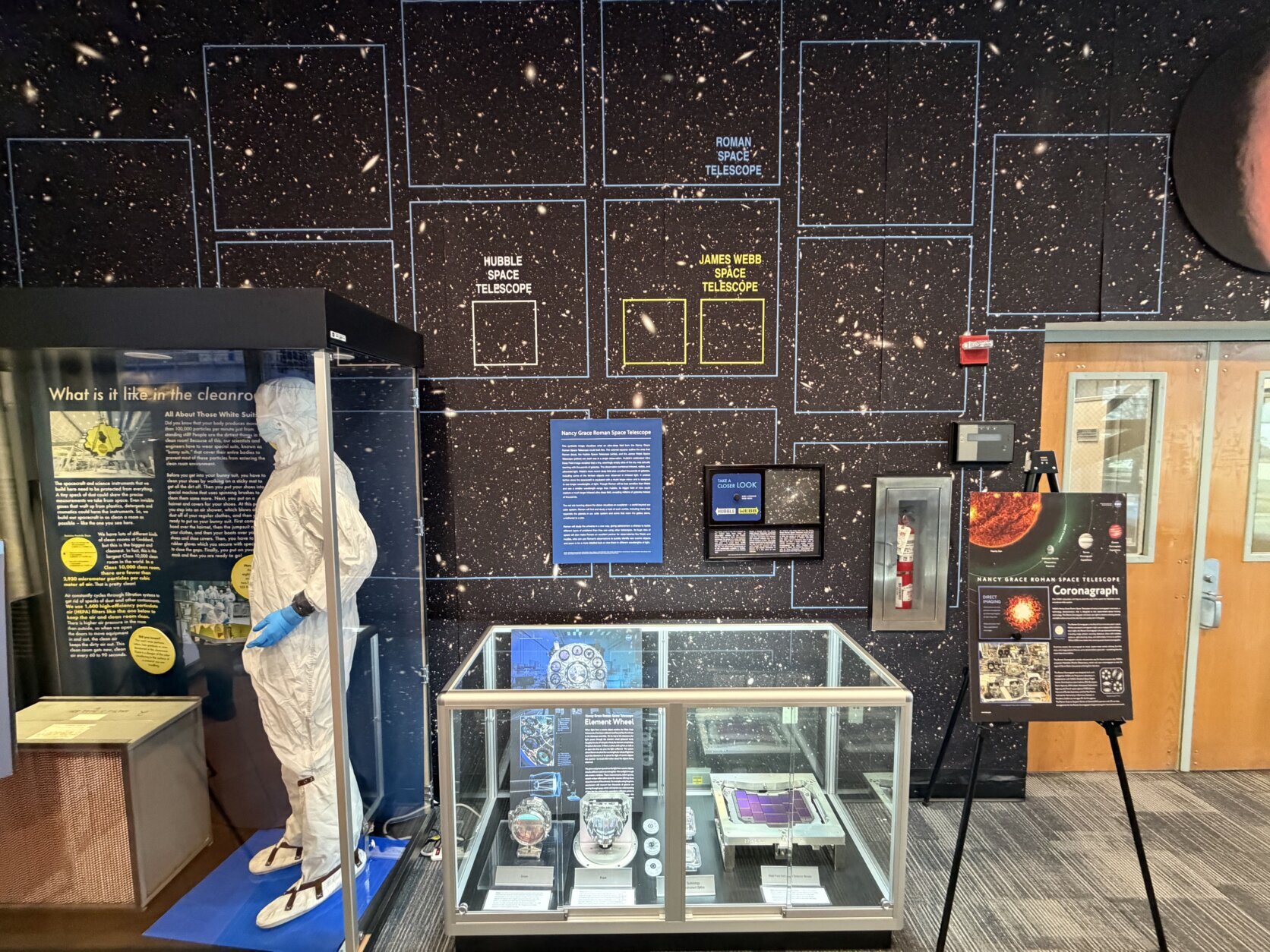
JWST has a very small field of view of the universe compared to the Roman Space Telescope. With its wide field of view, the Roman Space Telescope can image large sections of the sky and find new potential objects for Webb to observe. It is this large wide field of view and advanced imaging capability that makes the Roman Space Telescope so exciting.
The telescope will conduct three core surveys that “are designed to investigate some of the most profound mysteries in astrophysics while enabling expansive cosmic exploration that will revolutionize our understanding of the universe.”
Whenever astronomers have a new ground or space-based telescope, new instruments or new theories, we always advance in our knowledge of the universe. The Nancy Grace Roman Space Telescope would make its namesake, the first chief astronomer of NASA, very excited and proud.
Oh, the wonders we will see … and WTOP will keep you up to date.
Follow my daily blog to keep up with the latest news in astronomy and space exploration.
Get breaking news and daily headlines delivered to your email inbox by signing up here.
© 2026 WTOP. All Rights Reserved. This website is not intended for users located within the European Economic Area.
About the Author

Discover more from USA NEWS
Subscribe to get the latest posts sent to your email.


