
A sewer line breach in Maryland last month sent millions of gallons of raw sewage into the Potomac River, posing potential serious public health risks.
The Virginia Department of Health (VDH) said the spill occurred on January 19 when a sewer line in Montgomery County collapsed, causing more than 200 million gallons of wastewater to spill out.
DC Water, which is leading the cleanup, completed a bypass to reroute the sewage from the failed section of pipe by January 24.
President Donald Trump described the incident on Monday as an “ecological disaster,” and blamed state officials for the failure.
Why It Matters
The VDH has issued a recreational water advisory urging residents to avoid activities in the river, including swimming, wading, tubing, white-water canoeing or kayaking. It said people should avoid exposure to any sewage spill to prevent recreational water illnesses.
The Maryland Department of Health also ordered the closure of shellfish growing areas on January 25 from the spill location to the Harry W. Nice Bridge.
What To Know
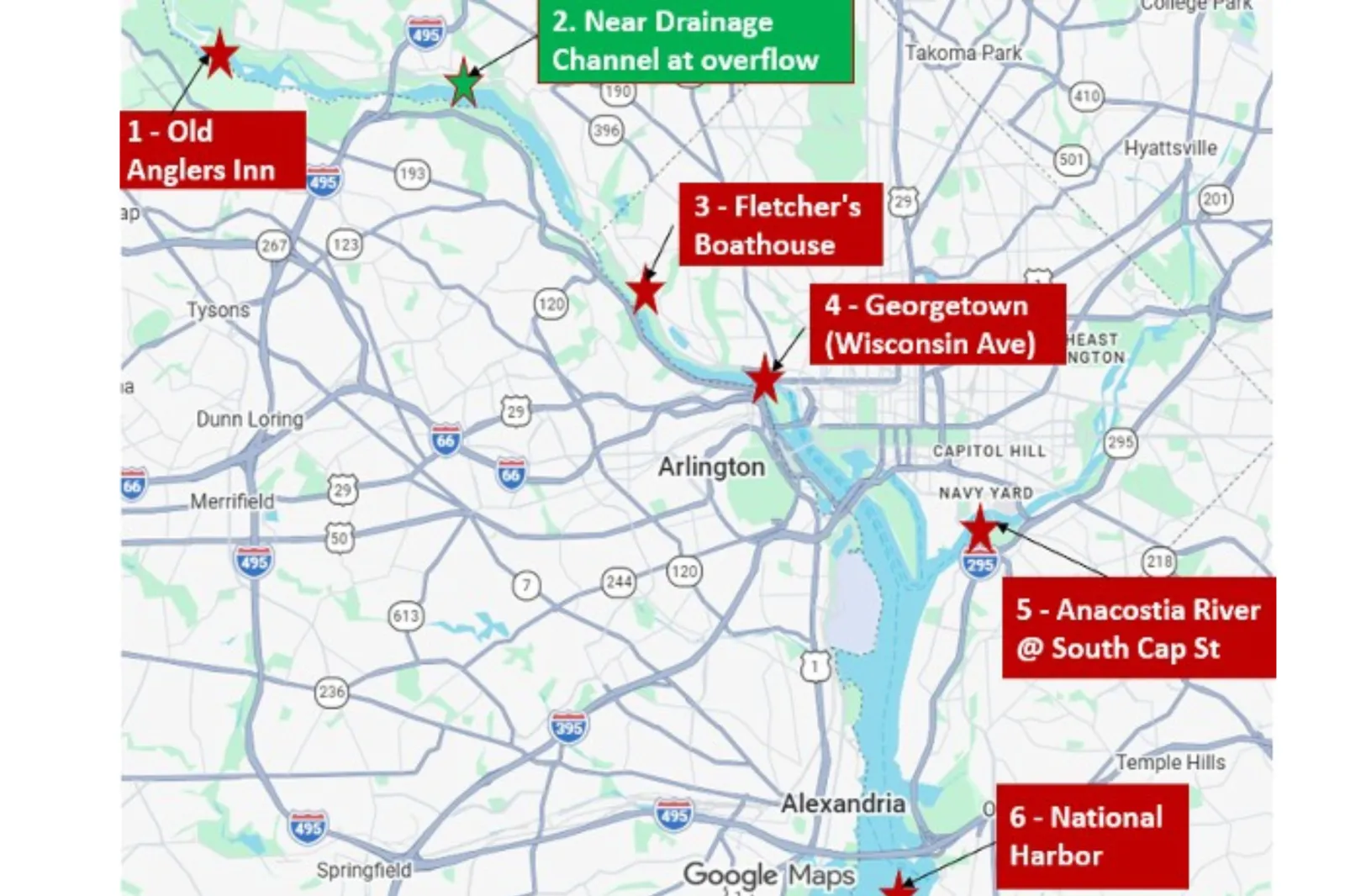
A map released by DC Water reveals the location of where the sewage spill occurred, along with the six locations where the authority is sampling for E. coli.
The authority said its work is now focused on clearing debris from the damaged pipe so that contractors can begin repairs.
It added that it is working on cleanup and remediation plans, which are in their early stages and will be focused on immediately impacted areas such as canals and the Potomac River. The cleanup measures will be decided upon in collaboration with federal, state and local agencies, it said.
DC Water started bacterial testing at the six sites on January 29. “Overall, results show mostly decreasing trends since the start of sampling,” it said.
It added: “Results at these sites, particularly the elevated concentrations observed at the overflow site in recent days, are expected as a result of limited overflow events that occurred. These are likely influenced by ice and snowmelt, which may increase system flows, contributing to overflow events during this emergency repair.
“Although the overflow is now mostly contained, E. coli levels are expected to continue fluctuating over time due to residual impacts from the incident and ongoing influences from weather conditions such as precipitation, snowmelt, temperature variability, and other natural sources of E. coli bacteria such as wildlife.”
The company said its drinking water system is separate from its wastewater infrastructure, and that drinking water remains safe.
What People Are Saying
President Donald Trump wrote on Truth Social on Monday: “There is a massive Ecological Disaster unfolding in the Potomac River as a result of the Gross Mismanagement of Local Democrat Leaders, particularly, Governor Wes Moore, of Maryland. A sewer line breach in Maryland has caused millions of gallons of raw sewage to be dumped directly into the Potomac River, a result of incompetent Local and State Management of Essential Waste Management Systems. This is the same Governor who cannot rebuild a Bridge.
“It is clear Local Authorities cannot adequately handle this calamity. Therefore, I am directing Federal Authorities to immediately provide all necessary Management, Direction, and Coordination to protect the Potomac, the Water Supply in the Capital Region, and our treasured National Resources in our Nation’s Capital City.
“While State and Local Authorities have failed to request needed Emergency Help, I cannot allow incompetent Local ‘Leadership’ to turn the River in the Heart of Washington into a Disaster Zone. As we saw in the Palisades, the Democrat War on Merit has real consequences. The Federal Government has no choice, but to step in. FEMA [The Federal Emergency Management Agency], which is currently being defunded by the Democrats, will play a key role in coordinating the response.”
David L. Gadis, CEO and general manager of DC Water, said in an open letter: “We recognize that describing response actions and infrastructure details does not erase the environmental impact or the concern this incident caused. For those who live near the river, recreate on it, or work every day to protect it, witnessing this unfold was distressing. We hear that clearly.
“This incident has also underscored a broader reality facing utilities across the country: much of the infrastructure that protects our waterways was built decades ago, long before today’s environmental standards, population growth, and climate pressures. The Potomac Interceptor—more than 60 years old—is a critical regional asset, conveying wastewater from across the metropolitan area to the Blue Plains Advanced Wastewater Treatment Plant. Its failure reinforces why sustained investment and vigilance are essential.”
What Happens Next
DC Water says work is continuing to remove rocks and clean out the affected pipe so crews can begin repairs. The authority is testing the river for E. coli, and posts daily updates on its website.
About the Author

Discover more from USA NEWS
Subscribe to get the latest posts sent to your email.


