
Spain has suffered its second major train crash in days after a derailment near Gelida in Catalonia on Tuesday evening killed the driver and injured at least 37 people, according to regional officials and emergency services.
Catalonia’s fire service said the Rodalies commuter train struck a retaining wall that had fallen onto the track between Gelida and Sant Sadurní amid heavy storms, and all passengers were evacuated from the train after one person trapped inside was rescued.
Why It Matters
The Barcelona-area crash occurred two days after a deadly high-speed collision near Adamuz in Andalusia, intensifying scrutiny of Spain’s rail safety as investigators probe what authorities described as a highly unusual sequence of events on a recently renovated line.
The high-speed crash near Adamuz was among Spain’s deadliest rail disasters in more than a decade, dealing a reputational blow to a system long seen as a symbol of national progress and efficiency and prompting three days of national mourning.
What To Know
In Tuesday’s crash, emergency services deployed 11 ambulances and 35 fire crews to Gelida, about 35 kilometers (21.7 miles) west of Barcelona, and evacuated injured passengers to Moisès Broggi, Bellvitge and Vilafranca hospitals. Five people were seriously injured, six were in less serious condition, and 26 were classified as mild.
The Catalonia crash has raised urgent questions about infrastructure resilience, maintenance and procedures during severe weather, as well as the causes behind the Adamuz derailment and collision.
Spain’s rail infrastructure manager, Adif, said a separate commuter train, different from the one that crashed near Gelida, derailed on Tuesday between Blanes and Maçanet-Massanes after an axle was struck by a storm-displaced rock, with no injuries reported and services suspended pending inspections.
“The axle was struck by a rock dislodged by the storm,” Adif said in a statement.
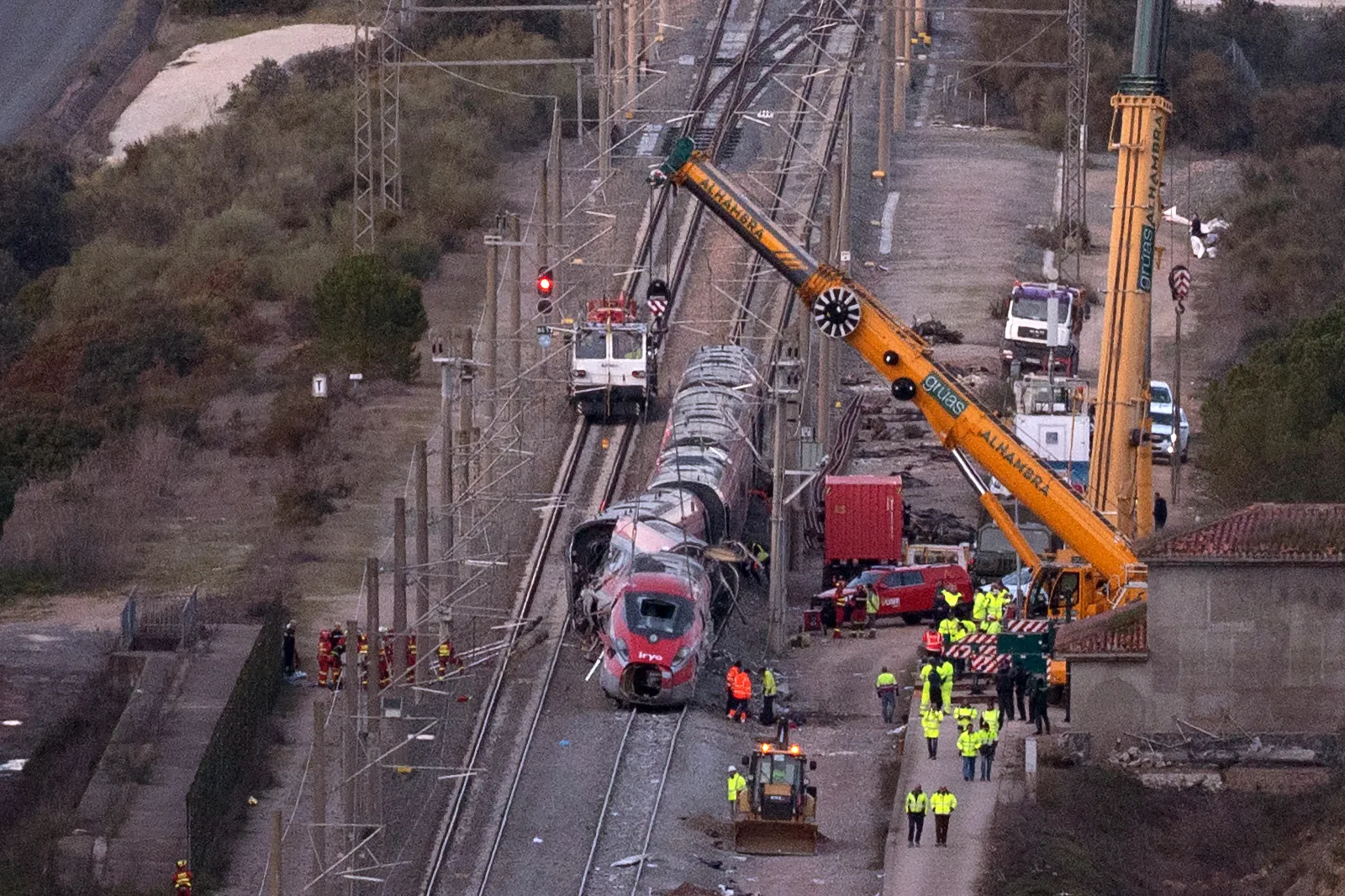
Sunday’s high-speed crash near Adamuz involved the derailment of the rear carriages of an Iryo train traveling from Málaga to Madrid, which then obstructed the adjacent track and were struck by an oncoming Renfe service bound for Huelva around 7:45 p.m., according to preliminary accounts.
The death toll from the Adamuz collision has grown as identification progresses, with officials reporting at least 42 fatalities as of Tuesday.
Renfe President Álvaro Fernández Heredia said that “human error was practically ruled out” at this stage, while Spain’s rail accident commission, CIAF, continues to investigate the causes of the crash.
What People Are Saying
Spanish Prime Minister Pedro Sánchez wrote on X after the Catalonia crash: “All my affection and solidarity with the victims and their families.”
Sánchez said after the Andalusia crash: “Spanish society is asking what happened, how it happened, and how this tragedy could have occurred.”
Spanish Transport Minister Óscar Puente told Spanish national radio RNE after the Andalusia crash: “It is undoubtably a hard blow, and I have to work so it doesn’t affect the credibility and strength of the network.”
Ignacio Barrón, the head of the CIAF, told RTVE: “What always plays a part in a derailment is the interaction between the track and the vehicle, and that is what the commission is currently [looking into].”
What Happens Next
Rodalies commuter services across the Barcelona network were suspended for safety checks, with Spanish newspaper El País reporting that about 400,000 commuters could face disruptions on Wednesday morning while authorities and operators meet after inspections.
Rail operators are expected to meet with authorities once those checks are finished.
Spain’s Transport Ministry suspended services between Madrid and Andalusian cities after the Adamuz crash and said initial findings from the investigation could take about a month, with the high-speed corridor partially closed as recovery and inspections continued.
About the Author

Discover more from USA NEWS
Subscribe to get the latest posts sent to your email.


